
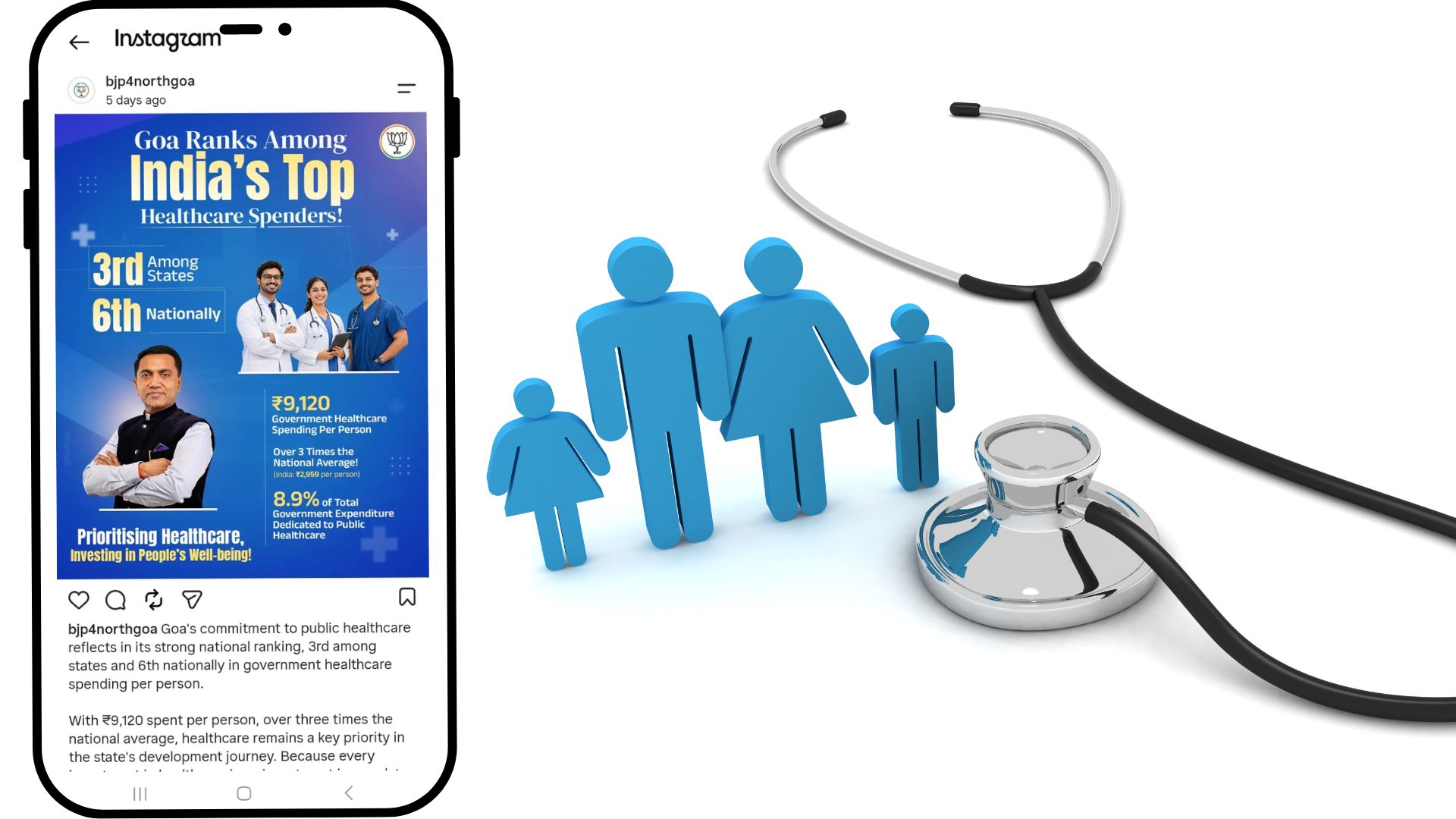
The latest National Health Accounts (NHA) 2023–24 report from the Union Ministry of Health and Family Welfare gives Goa plenty to boast about.
Among India’s 28 states, Goa ranks third in public healthcare spending — and sixth overall when Union Territories are included. At Rs 9,120 per person, the state spends more than triple the national average, dedicating 8.9% of its total budget to health. On paper, Goa looks like a model welfare state, comfortably clearing the National Health Policy’s 8% budgetary benchmark. Walk through a government hospital corridor in Goa, however, and that statistical success feels far away.
Public health expenditure is tracked closely because it signals a government’s intent to protect citizens from medical debt and build long-term human capital. Yet for ordinary Goans navigating state-run facilities, daily reality rarely matches the optimism of national scorecards.
Senior citizens praised in national indices for living in India’s best state for active ageing still stand in long queues for routine check-ups, or travel dozens of kilometres just to get a basic diagnostic scan. Families crowd hospital corridors waiting on delayed surgeries, unavailable specialists, and beds spilling into wards.
The flaw in celebrating expenditure rankings is simple: budgets measure money going in, not care coming out. Allocating funds is only the starting point; what matters is whether that money turns into reliable, accessible treatment at the ground level.
Across India, and Goa is no exception, large health budgets are easily absorbed by administrative overhead, steep procurement costs, and building projects that outpace hiring.
New hospital wings and expensive diagnostic machines achieve very little when they sit underused because there are not enough doctors, nurses, and technicians to run them.
In Goa, this gap between headline numbers and patient experience shows up most clearly at Goa Medical College (GMC) in Bambolim. Although the state has a dense network of primary health centres and newly upgraded district hospitals, peripheral facilities often lack specialized departments and round-the-clock specialist cover.
As a result, patients from across Goa are routinely referred to GMC for anything beyond basic treatment, leading to overcrowded wards, stretched infrastructure, and long waiting lists for routine surgeries and specialised scans.
High per-capita spending means little if an entire state’s healthcare system leans on a single tertiary hospital to stay afloat.
Per-capita figures also look higher in smaller states like Goa, Sikkim and Mizoram for purely mathematical reasons. Fixed costs, such as maintaining tertiary hospitals, running emergency ambulance networks, and funding specialist departments, are divided across a much smaller population, making per-person spending appear larger than in bigger states.
At the same time, Goa’s public hospitals serve far more people than just permanent residents. Tourists, migrant workers and patients from neighbouring border districts all rely on the state’s medical infrastructure.
Providing care to everyone who needs it is the right thing to do on humanitarian grounds, but it stretches staff and facilities thin, diluting what each tax-paying resident actually experiences.
Heavy budgetary spending has also failed to eliminate out-of-pocket costs for everyday families. Medicine shortages at hospital pharmacies, long waits for diagnostic appointments, and broken equipment routinely push patients toward private clinics and labs.
Meanwhile, a sizable share of Goa’s health budget goes into state-backed insurance schemes such as the Deen Dayal Swasthya Seva Yojana (DDSSY). While cashless coverage helps many families afford treatment, leaning too heavily on insurance models channels public funds into private hospitals instead of strengthening government facilities for the long term.
A reliable healthcare system also needs transparent governance and accountability. Goa’s health sector still lacks independent performance audits that track patient satisfaction, treatment success rates, and post-operative recovery — metrics that matter far more than budget spreadsheets.
Meanwhile, rapid demographic shifts, including a growing elderly population and rising cases of diabetes and hypertension, call for dedicated geriatric and palliative care units that current spending has largely failed to build on the ground.
National rankings carry a real risk of breeding complacency among policy-makers. When reports consistently tell the administration that Goa is among the best in the country, the urgency to fill vacant specialist posts in South Goa, upgrade taluka level diagnostics, and audit hospital delivery inevitably fades.
Goa already has foundational strengths that many states envy, including high literacy, solid baseline health indicators, and the fiscal room to invest in public welfare.
Bridging the gap between statistical success and lived reality requires shifting focus from how much money the state spends to how well the system works for the citizen standing in line.
Until a Goan resident can walk into a district hospital and receive timely, specialised care without being sent to an overcrowded referral hub or a private clinic, these national rankings will remain better on paper than in practice.
Pachu Menon is a senior columnist and author of seven books. Besides touching on topics of national interest, he writes incisively on Goan politics, tourism, and social change
Comments (0)
Please login to post a comment.
No comments yet. Be the first to comment!