
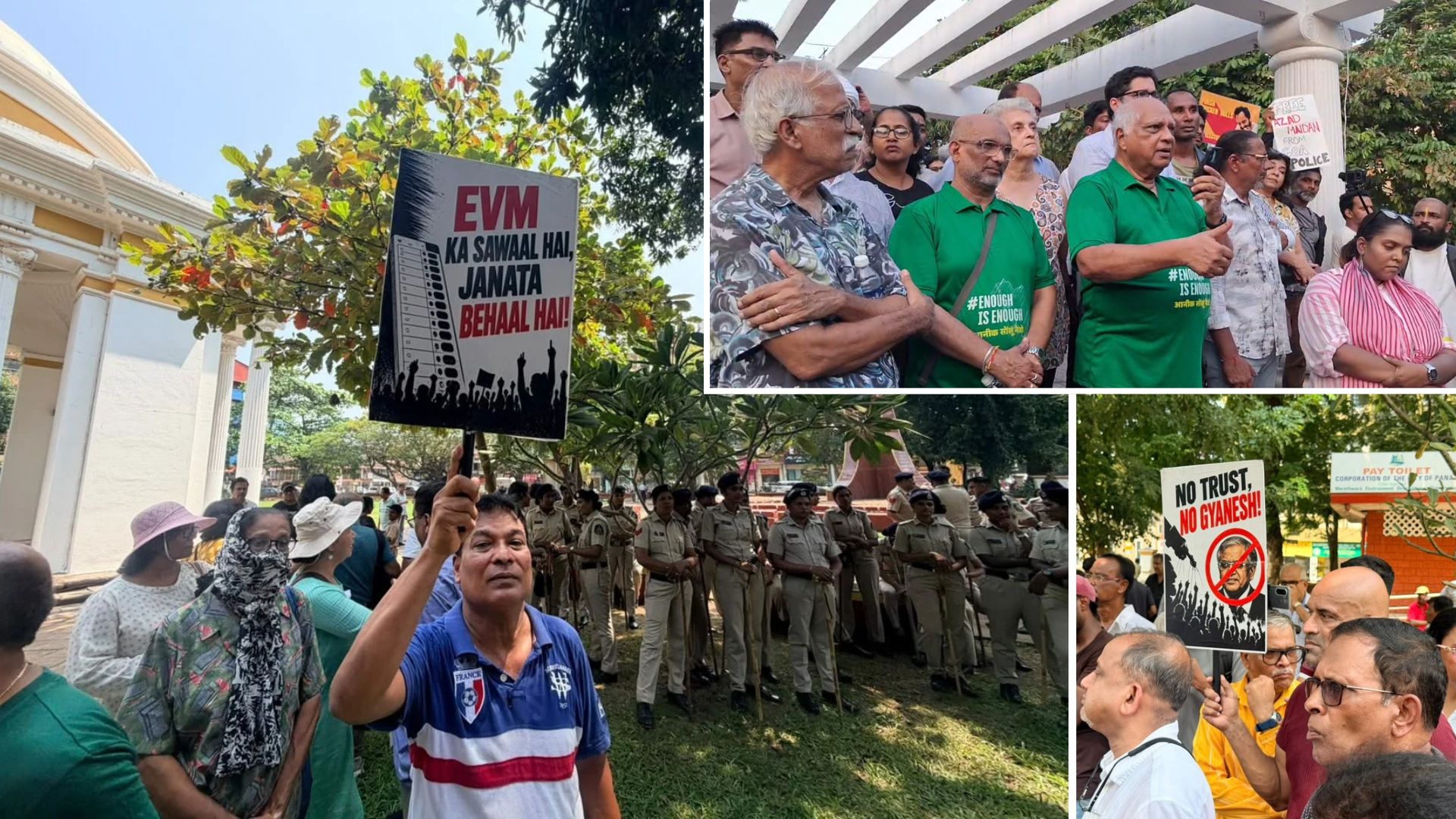
Goa, at times, has been singled out for not paying enough attention to matters of national interest. It possibly may have been so in the past, but is definitely not the trend currently and the protest in Panjim on Sunday, October 11, 2026, effectively demolishes this argument. Unlike other times, Goa, on this Sunday, was not protesting to protect its land, identity, language or environment, but took to the streets to protect citizens’ electoral rights, an issue that is agitating the country.
That, however, is just part of the story, for what occurred on that Sunday evening tells us much about the state of democracy and why Goans should take an interest in a movement centred on electoral accountability. Ironically, citizens who were demanding that nobody be denied the right to vote were themselves being denied the right to protest, and that’s what makes this a matter of concern.
In a representative democracy, voting rights are fundamental to the citizens, who if denied this right will be prevented from participating in electing a government of their choice. Similarly, in a democracy one also has the right to peaceful protest. That’s all that the people were doing on Sunday evening in Panjim—exercising their right to protest as the special intensive revision (SIR) of the electoral roll has raised several questions that require answers.
They were not given the opportunity to protest and that decision turned an otherwise regular protest into something much stronger, for had the meeting been permitted with minimal police presence, its impact would have been far less. The revocation of permission altered the dynamics of the protest.
Of course, the rather sizeable number of people, including a retired Chief Justice of a High Court, a Padma Shri awardee, and others, leading to a broad cross-section of Goans represented, also lent the protest an intellectual quality.
The events of Sunday have led to raised eyebrows, frayed tempers, detentions and an emergency sitting of the High Court of Bombay at Goa. The events were such—permission for the CJP protest at Azad Maidan on October 11 was denied and the gates to the maidan were locked, yet the protestors went ahead, some vaulting into the maidan, leading to the detention of seven persons. It was only after the High Court of Bombay at Goa was hurriedly petitioned on a Sunday, and heard the petitioners the same evening, that those who were detained were released.
All what occurred brings into focus questions that extend beyond a single demonstration. The denial of permission for a protest organised by the Cockroach Janata Party (CJP), the detention of seven protesters and their subsequent release on the intervention of the High Court of Bombay at Goa raise valid questions about the right to peaceful protest and the exercise of administrative authority.
Despite the protest being called by the CJP, this cannot be termed a political movement. Not yet. It is still a group of citizens seeking accurate electoral rolls, transparent voter-registration procedures, accessible correction mechanisms. There is also, at the current time, little to view the CJP as an emerging political force in Goa. It still remains a movement.
This differentiation is important for Goa as the state will be voting for a new government in about four months from now. CJP, given that Goa is a small state, may be tempted to test the electoral waters, but then, it does not boast of an organisational presence, nor has been able to penetrate across the state. A call for a meeting is far different from a call to vote, besides, the gathering in Panjim was not representative of entire Goa.
Aside from that, citizens expressing their dissent peacefully should be permitted to do so.
The writer is a senior journalist, author and editor
Comments (0)
Please login to post a comment.
No comments yet. Be the first to comment!