
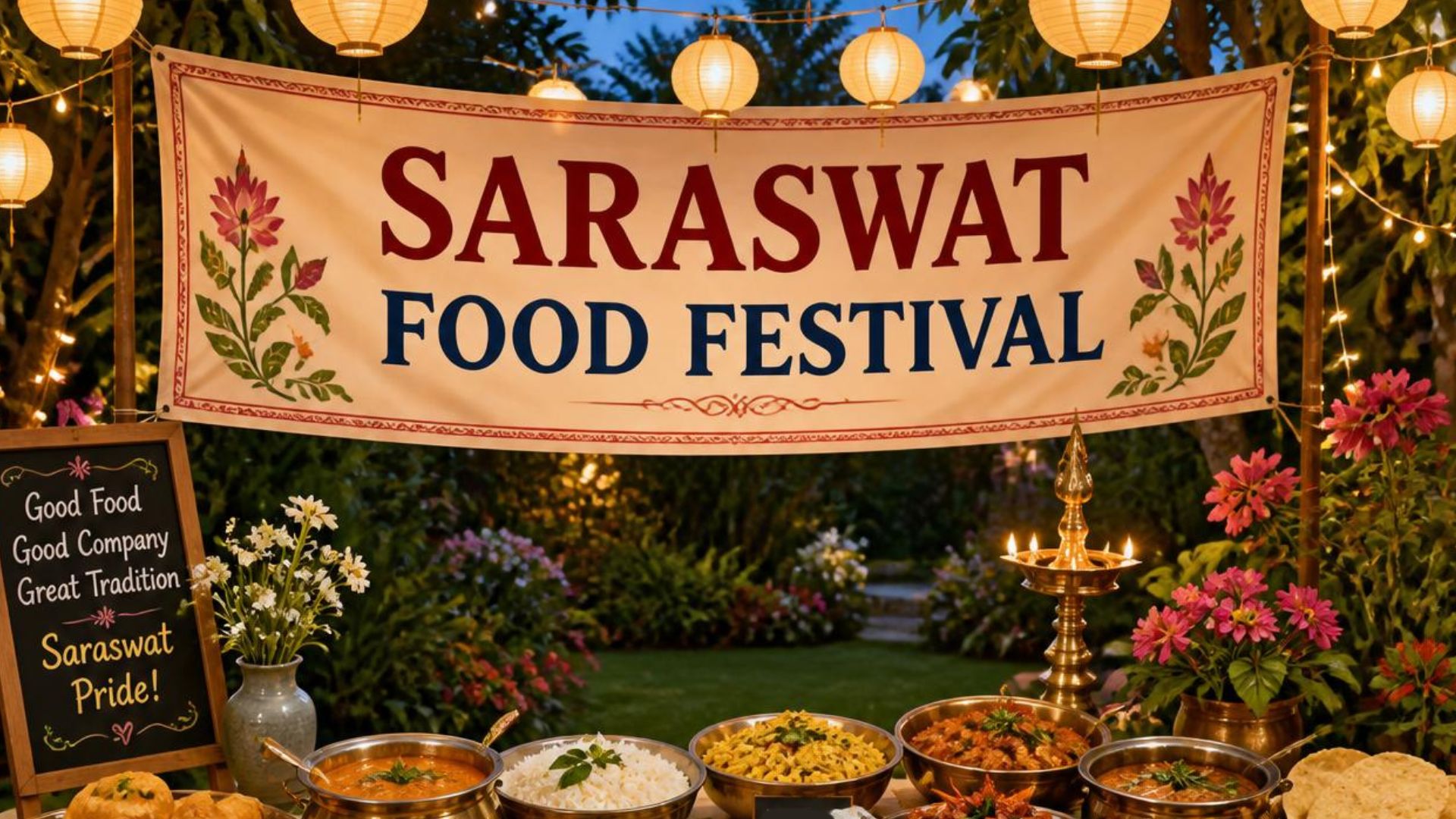
Saraswat food. Saraswat cuisine. Saraswat thali. Hotels in Goa run festivals under this banner. Tour operators put it in the title of cooking classes. Newspapers write it without quotation marks. Wikipedia has a page for it.
Why are we hearing this everywhere?
LET'S START WITH THE LABEL
In 1943, a book came out. Rasachandrika, printed by the Saraswat Mahila Samaj in Bombay. And, it was not only a recipe book. It was a guide for the modern Saraswat woman of that period: recipes, home remedies, a calendar of Hindu festivals, advice on running a household, all in one volume [1].
It sold around a thousand copies in its first month [2]. It went into Marathi, then Hindi and English, through nine printings, and it is still on sale today.
That book unknowingly became the first document to formally coin something called ‘Saraswat food’. And, every dish written inside it became, from then on, a Saraswat dish.
The Samaj that published it had been set up in 1917 by Sitabai Padbidri and Shantabai Sirur, inside a dense little ecosystem of community institutions: the Shamrao Vithal Co-operative Bank in 1906, the Saraswat Co-operative Housing Society at Gamdevi in March 1915, then the women's samaj two years after that [1]. A caste association had been running since 1911, with a quarterly magazine from 1919 that went monthly in 1929.
Note where all of that is. Bombay. And note whose food the book actually contains. Rasachandrika records the recipes of the Chitrapur Saraswats, whose math has sat at Shirali in North Karnataka since the eighteenth century. Scroll.in's account of the book is careful about it: it documents the food of "the Konkani-speaking community of Chitrapur Saraswat Brahmins (and to some extent, by default, the Gaud Saraswat Brahmins)" [2].
By default. The Goan Saraswats were a rounding error in the book that would later be used to define Goan Hindu food. Every other community in Goa was not in it at all.
WHAT DOES THE AUTHOR SAY?
Here is the problem with the whole thing, and it is sitting on page nine of the book, in the author's note [3].
"However, some select dishes belonging to other communities, which may be popular amongst Saraswats, are also included in this book."
Some of these dishes belong to other people. She wrote that. It is in the founding document, before anybody built anything on top of it.
And a few lines above it, this:
"Diet varies according to climate and locally available ingredients. This is why cooking differs in different places."
Cuisine comes from climate and from what grows nearby. That is the author's own opening premise, in the book that started all of this. There is a third line on the same page worth holding on to, because it turns up again later doing work it was never meant to do:
"Traditional Saraswat cooking is not very spicy and is therefore nutritious and good for health." A household describing its own cooking, framed as a health virtue.
WHY THIS BOOK AND NOT SOMEBODY ELSE'S
The book became the face of Saraswat cooking, and nothing else became the face of anything, because of who had access to education and print.
Parag Parobo's Goa University thesis records it directly: "With the GSBs readily taking to the study of English, they made the most of these employment opportunities" [4]. Early English education, then clerical and professional work, then migration to Bombay, then institutions to hold the community together: a bank, a housing society, a women's samaj, a caste association, a monthly magazine with a subscriber list which I mentioned earlier. By 1943, there was a community with an audience, a distribution network and a print market. Nobody else in Goa had that combination.
So, more books followed on the same premise, each one taking regional food and presenting it as community food. And, the category compounded.
Arjun Appadurai described this exact mechanism in 1988, in a paper on Indian cookbooks. His finding was that "certain linguistic and regional traditions with greater access to urban resources, institutions, and media are pushing humbler neighbors out of the cosmopolitan view." He also named the move: the standard device of cookbook-making is "to inflate and reify an historically special tradition and make it serve, metonymously, for the whole" [5]. He was watching Tamil push out Telugu, and Bengali push out Oriya. The same thing happened here.
THEN CAME THE FESTIVALS, THE PRESS AND THE SEARCH RESULTS
A category with a book behind it and nobody contesting it eventually acquires buildings, budgets and a search ranking.
The Saraswat Food Festival in Goa has run for roughly two decades, organised by branches of the Goa Saraswat Samaj. Its start year is unsettled, which is itself telling: a Times of India report from 2011 says it began in 2001 in Panaji [6], while Malavika Neurekar's essay dates it to 2004 [7]. Nevertheless, what it presents, year after year, is Goan food, under a community's name.
The organisers stress that it is open to everyone and that entry is free [8], and I believe them. The festival has never claimed these dishes belong only to Saraswats even after festival being named as Saraswat food festival. It does something more effective than that. Neurekar quotes a senior member of the Samaj explaining why they started it: "When tourists come to Goa, looking for a taste of our culture, all they get is foreign food. This is one of the reasons we initiated the Saraswat Food Festival, so tourists can get the real taste of Goa" [7].
The real taste of Goa. Not the real taste of our community. That slide is the whole mechanism in one sentence. Meanwhile the competitions, the stalls and the felicitations at the festival are reserved for members of the community [7].
Then the media coverage arrived, people started writing blogs and articles around Saraswat food, Youtube videos stressing on the same cuisine. People outside Goa, even celebrities began to file Goan cuisine and Saraswat cuisine as two separate things. Then, the restaurants and hotels followed. Cidade de Goa ran a “Goan Saraswat Cuisine“ festival at Café Azul in 2017 and again in 2018 [9]. In 2024, Taj Exotica's Miguel Arcanjo, billed as its “quintessentially Goan” restaurant, filled that brief with a Saraswat menu [10]. Tour operators now sell “typical Goan Saraswat cuisine” cooking classes whose own descriptions, further down the page, call the recipes simply Hindu Goan.
All of these things quietly shifted the SEO. Search engines learn from whatever gets written most confidently and most often. Twenty years of festival listings, hotel press releases, recipe blogs, videos, celebrity bytes and travel copy taught them that Goan Saraswat cuisine is a thing, so now they return it as one. Type it into Google and the results page looks like evidence.
And then, the reference layer closed the loop. The English Wikipedia article titled "Saraswat cuisine" opens with this sentence: "Konkani cuisine is the cuisine of the Saraswat Brahmins from the Konkan region on the western coast of India" [11]. A language's name and a region's name, absorbed into a caste's, in the first line of the most-read reference work on earth. The article carries a citation-needed banner from March 2013 and has four footnotes.
NOW LET'S LOOK AT THE ACTUAL DISHES
Everything above is apparatus. Here is what happens when you check it against the food.
Goan fish curry. Batatachi kaap. Sol kadi. Kismur. Khatkhate. These are made in Goan households every week, in every district, across communities. That is not an impression. It is what the sources say when you read them next to each other.
Start with the dish list on that Wikipedia page. It names khatkhatem, patoleo, hooman ani xit and kokumachi kadhi [11]. Now open the same encyclopedia's article on Goan cuisine. Under the heading "Goan Hindu cuisine" you will find humann, kismur, sungtache dangar, tondak, patoli, khatkhate and solanchi kadi. The word Saraswat does not appear on that page once [12].
One encyclopedia. Two articles. Substantially the same dishes, assigned once to a caste and once to a religion-wide regional category.
Khatkhate. Wikipedia's own article on it calls it "a mixed vegetable stew prepared in Goan Hindu cuisine", and the link behind that phrase points to the Goan cuisine page, not the Saraswat one. The only Saraswat mention on it concerns the surname Khatkhate, in a section the editors have flagged for splitting off [13]. A reader skims, sees "Saraswat Brahmin" in the opening lines, and the caste transfers to the stew by proximity.
Sol kadi does not even get that far. The Wikipedia article on it names no community at all. It locates the drink in Sindhudurg, Ratnagiri, Goa, Mangalore and Belagavi [15]. That is a map, not a caste.
Kismur is filed under Goan Hindu cuisine, not Saraswat cuisine, in the same encyclopedia [12]. It is dried mackerel or prawn with coconut and onion, which is to say it is what you make from the fish you dried during the monsoon ban. That is a fishing economy, not a caste practice.
And batatachi kaap is fried potato. The potato arrived in India with the Portuguese, and Neurekar notes that Goan Hindus initially rejected potatoes and tomatoes as foreign imports [7]. A rava-fried potato slice cannot be the ancient property of anybody. It is a colonial-era vegetable that every Goan kitchen eventually adopted and now fries the same way.
ONE DISH, THREE COMMUNITIES, THREE CALENDARS
Patoleo settles it. Turmeric-leaf parcels of rice, coconut and jaggery. Konkani-speaking Hindus make them for Nag Panchami and on the Shravan Sundays. Goan Catholics make them on 15 August for Konsachem Fest, the harvest feast of the Assumption [16]. And, a documentation project funded by the Ministry of Tribal Affairs, run out of Government College Quepem since June 2023, has recorded a Gawda, Velip and Kunbi version called Fhaterphodi Pannachyo Patholyo, one of 75 tribal recipes it has put on the record for the first time [17].
Three communities. Three unrelated reasons to cook it. One dish. Wikipedia files it across four separate pages under four different community labels, and each page is written as though the other three do not exist.
A dish that turns up in a Brahmin kitchen for Nag Panchami, a Catholic kitchen for the Assumption and a Kunbi kitchen in Canacona is not the property of any of them.
BECAUSE GOA HAS COCONUT, KOKUM, TEFLAM AND FISH
There is no mystery about why these dishes are everywhere. Goa has the ingredients, in quantity, within reach of everyone.
Teflam is Zanthoxylum rhetsa, described by Roxburgh in 1820 [18]. Its dried pericarp goes into seafood curries right along the Goa, Konkan and Karnataka coasts, and it is the thing that makes a fish curry taste like it came from here [19]. Kokum grows here. Coconut grows here. The sea is forty minutes from almost anywhere in the state.
A 2022 Goa University doctoral thesis on Goan food history puts the consequence plainly: fish-curry-rice, xit-coddi ani nustem, "form the staple diet of a vast section of Goan people through the ages" [20]. A vast section. Not a caste section.
Cooking with what a coastline hands you is not a cultural achievement one community holds the deed to. It is what everyone within reach of the same soil ends up doing. Abundance of an ingredient does not make a dish community-specific.
AND LESS SPICE IS NOT A CUISINE
So how does the encyclopedia actually define the thing? Like this: "Their cuisine is less spicy and has less Portuguese cuisine influences than the cuisine of their Goan Catholic counterparts" [11].
Read it again. That is a comparison, not a definition. It tells you the cuisine has less of two things than the neighbours have. Take the neighbours away and there is no sentence left. You cannot identify a plate of food as belonging to this cuisine without first setting a Catholic or a more spicy Hindu plate beside it.
And, you have already met the source of that line. It is the health-virtue sentence from page nine of the Rasachandrika author's note mentioned earlier [3]. A household's remark about its own cooking, promoted over eighty years into the defining property of a cuisine.
Try to find any other rule that holds and the sources start contradicting each other. The Saraswat framing leans hard on satvik cooking without onion or garlic; Wikipedia's Goan Hindu cuisine section says onion and garlic are used [12]. The 2022 Goa University thesis states that "the Brahmin diet excludes fish as they eat only vegetables and pulses" [20]; a peer-reviewed 2021 history of Goan food says the reverse, that Brahmins "are strict vegetarians in most of India, but in Goa, they (Saraswats) regularly consume fish" [21]. Two academic sources, same state, incompatible claims. And, the label itself stretches across Chitrapur Saraswats in Karnataka and Gaud Saraswats in Goa, separated by a sixteenth-century migration and a few hundred kilometres of coast [2].
If the boundary is the caste, the food should be the same. If the boundary is the coast, the caste is doing no work at all.
WHAT A REAL GOAN FOOD BOUNDARY LOOKS LIKE
India does have a formal system for deciding who a food belongs to, and it draws exactly the boundary this label refuses to.
Goa holds fifteen registered geographical indications [22]. Twelve are farm produce: Khola chilli, Harmal chilli, Myndoli banana, Mankurad mango, Korgut rice, Agassaim brinjal, Taleigao brinjal and the rest. Three are things you would call a dish or a drink: Khaje, Bebinca and Feni. Every one of them is defined by a place. A village, a soil, a stretch of coast. Not one is defined by a caste, and not one of the dishes in this argument holds a GI at all.
When Goa is asked officially who its food belongs to, the answer comes back as geography. It is only in the tourism copy that the answer comes back as a community.
WHO GETS WRITTEN OUT
This is the part that actually matters, and the community it erases hardest is not the one I expected.
Bhandaris are the largest caste group in Goa, reportedly over 30 per cent of the state's Hindu population, and their traditional work is tapping and fermenting toddy [23]. Toddy vinegar is what makes sorpotel sorpotel and vindaloo vindaloo. Toddy is what leavens sanna, and what leavens Goan pão. Two of the dishes most loudly labelled Portuguese-Catholic, and one of the things most loudly labelled Goan, all rest on a product made by an OBC caste that appears on nobody's menu. There are now fewer than 200 active rendeirs left in the state [24].
The Kharvi who lands the mackerel, the rendeir who taps the palm, the Kunbi who has been making patoleo in a Canacona kitchen for longer than any of these books have existed: The Gauda who has the farming skills and Dhangars who did the milk business: none of them appear in the sentence when the dish gets filed under a caste.
WHAT I AM NOT SAYING
I am not saying the Saraswat community did nothing for Goan food. They did a great deal. They wrote it down when nobody else was writing it down, they kept recipes alive that would otherwise have gone, and they are still doing it. And, I am glad somebody did it.
But documenting a cuisine and owning it are two different acts. Claiming an entire regional cuisine as your own nullifies what every other community put into it. And, getting there first because you had the printing, the education and the media should not be the thing that decides whose food gets a name and whose does not.
The book that started all of this said it on page nine, before any of the rest of it happened. Diet varies according to climate and locally available ingredients. This is why cooking differs in different places [3]. Places. Not castes.
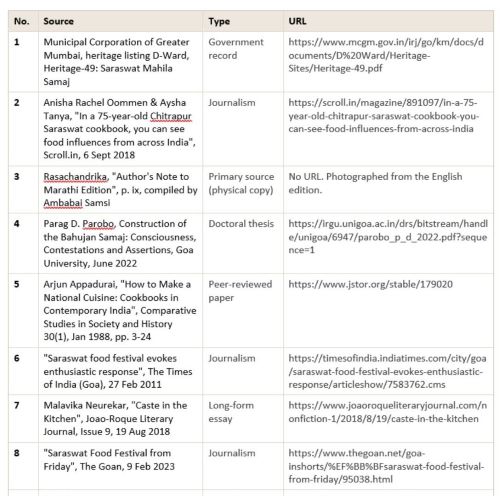
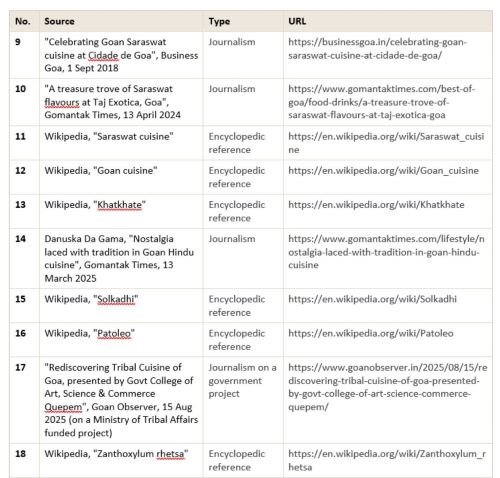
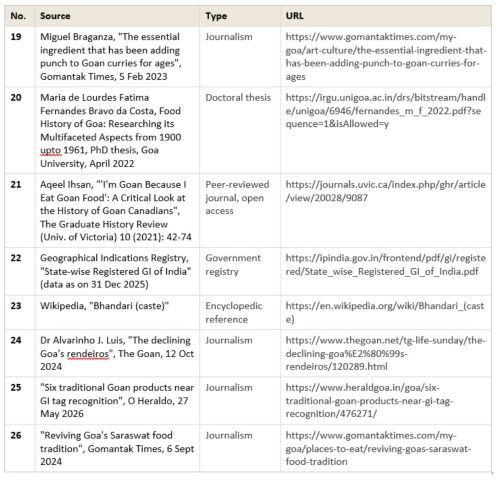
SOURCES
The writer is a postgraduate from Goa Institute of Management, a marketing consultant specialising in the MSME sector, and the creator of the page boldmonk.creates
Comments (0)
Please login to post a comment.
No comments yet. Be the first to comment!