

It was an unusual sight earlier this week on the busy St Cruz road that leads to Taleigao. For the first time, birders have sighted flamingos at these wetlands. This place, which is otherwise a haven for water birds such as egrets, ducks and storks, has now witnessed a special sighting of flamingos.
Ankush Sahani, a member of Goa Bird Conservation Network (GBCN) informs that this is probably the first sighting of these birds in St Cruz, and that too in such large numbers. “They were first seen by Vaishnavi Naik on Sunday. This year’s only sighting is the one in St Cruz right now,” says Ankush.
WINTER STOP
This is not the first time flamingos have been spotted in Goa. They have previously been sighted at the Agassaim mudflats and the Curtorim wetlands.
Flamingos are migratory birds that come to India from Central Asia and Africa. They arrive during the winter season to breed and migrate again as the monsoon sets in. They are not seen in small numbers; thousands of these wading birds are found in and around Navi Mumbai, Thane, the Rann of Kutch in Gujarat, and Odisha, among other places. In India, two species are commonly seen – Lesser Flamingos and Greater Flamingos. The flamingos spotted at the St Cruz wetlands are Greater Flamingos.
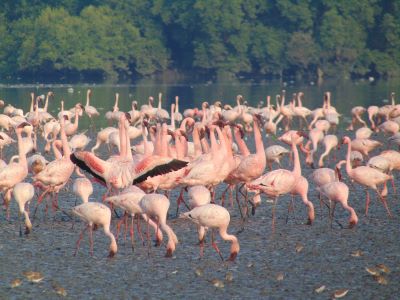
Flamingos are migratory birds usually seen in places like Navi Mumbai, Thane, etc. PHOTO: Arti Das
COLOURS OF GOA
They are mostly seen around mudflats and wetlands, as they feed on crustaceans, aquatic plants, and blue-green algae found in these habitats. Interestingly, it is this algae that is mainly responsible for their pink colour, due to the carotenoid pigments present in it. When these birds arrive, they are greyish in colour, but after feeding for some time, they gradually turn pink.
LOST IN TRANSIT
Birding expert Parag Rangnekar informs that the current sighting of flamingos at St Cruz is the largest recorded in Goa so far. He added, “Goa is not traditionally on the migratory route of flamingos, though a few stragglers are occasionally seen. This could be one such case. This is the time when they fly back to their breeding grounds, and this group may have deviated from its usual path and landed in Goa. It is usually sub-adult birds that stray, as seen in this case and earlier sightings.”
GROUND REALITIES
Ankush, who has been documenting the St Cruz wetlands for the past two years, further says that the site is a haven for birds, offering birders an opportunity to spot some rare species.
Last December, Mallard ducks were seen at the same spot where the flamingos are currently present. In the surrounding fields, sightings of Red-necked Falcon and Red-throated Pipit were also recorded. All these birds are rare, but the wetland is threatened by water pollution and the dumping of garbage and waste,” states Ankush, who is pursuing his master’s in Zoology.
“This rare sighting of flamingos along this bustling semi-urban road is encouraging. However, it is high time we conserve such habitats for these rare birds and other forms of wildlife in order to preserve the ecological balance and add colour and beauty to our lives,” he adds.
Arti Das is a Goa-based freelance journalist who enjoys writing about art, culture and ecology
Comments (0)
Please login to post a comment.
No comments yet. Be the first to comment!