
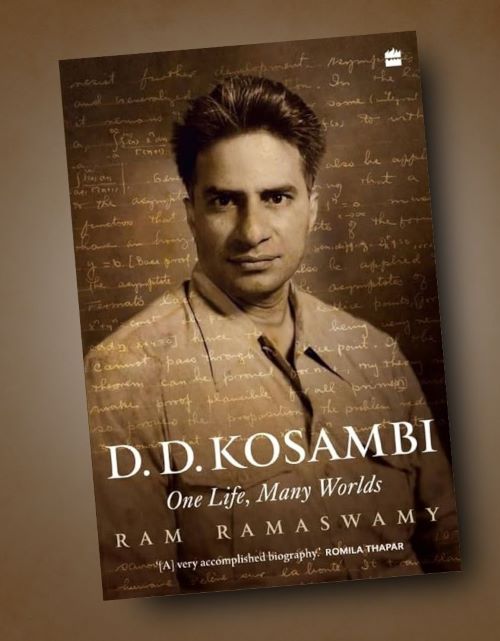
The son of Goan soil, Damodar Dharmanand Kosambi (1907-1966) – a celebrated polymath who was a Marxist historian, mathematician, indologist, philologist – has contributed immensely to Indian intellectual tradition. In Goa, we have the annual lecture series DD Kosambi Festival of Ideas named after him (organised by the Goa Government since 2008), but not much is known about his work or his life to a larger audience.
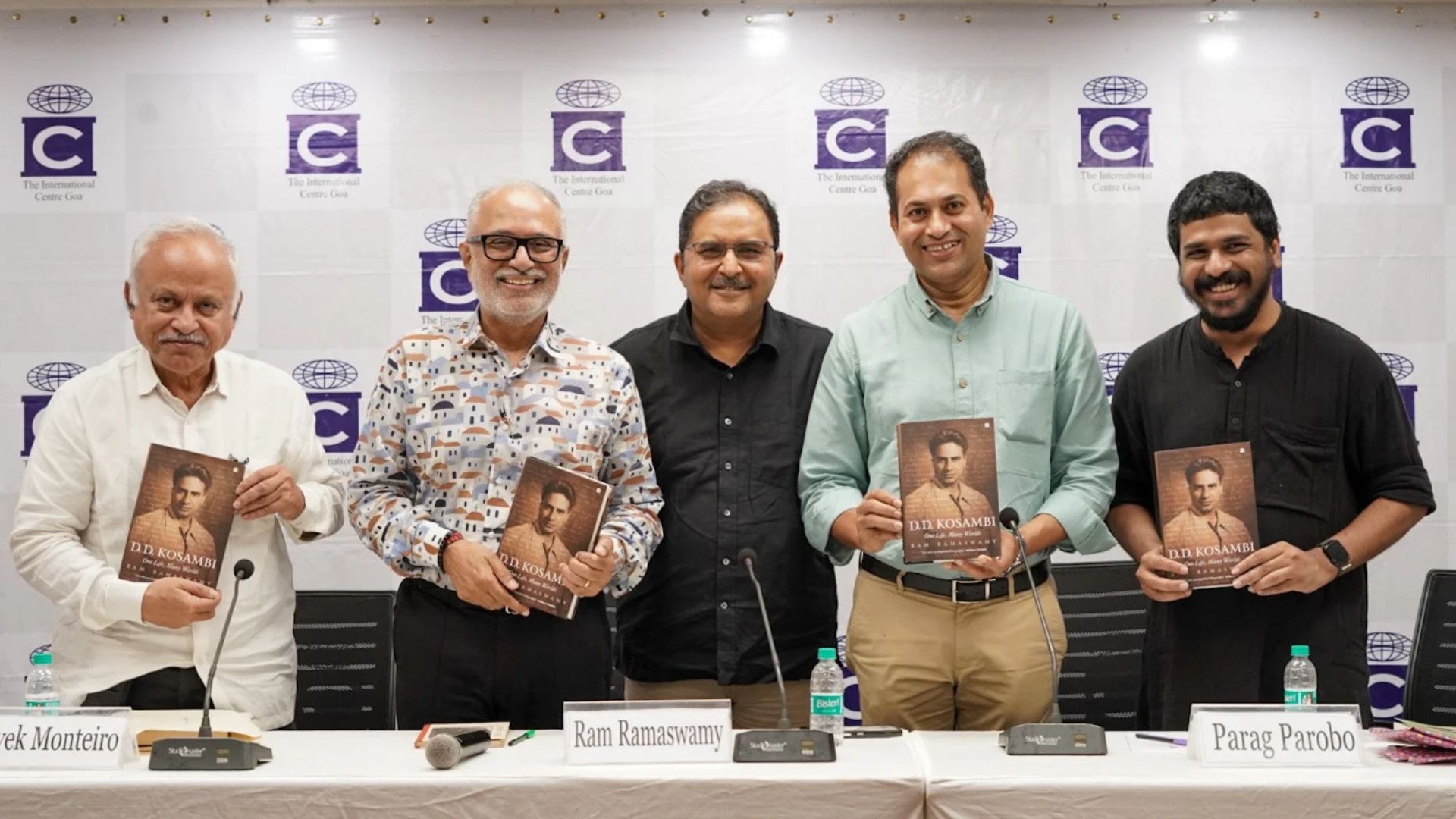
The new book, D. D. Kosambi – One Life, Many Worlds, by Delhi-based scientist Ram Ramaswamy, who is the D. D. Kosambi Chair in Interdisciplinary Studies at Goa University, was recently released at the International Centre Goa, Dona Paula, in association with Goa University, on the occasion of Kosambi’s 119th birth anniversary on July 31, tries to answer this question.
The 350-page odd book is divided into 15 chapters that delve into Damodar Kosambi’s early life in the US, where he studied, his work at the Tata Institute of Fundamental Research (TIFR), about his father Dharmanand Kosambi, etc.
The book was released by Vivek Monteiro, vice-president, Centre of Indian Trade Unions Maharashtra, Parag Parobo, associate professor in History, D. D. Kosambi School of Social Sciences and Behavioural Studies, Goa University, and Kaustubh Naik who is a doctoral candidate at the Department of South Asian Studies, University of Pennsylvania, along with the author.
A MAN WITH A VISION
In his address, Monteiro stated that this book is actually a biography of two — DD Kosambi and his father, Dharmanand Kosambi and his role in the formation of Damodar Kosambi. He added that DD Kosambi was forward-looking who had a vision, and it is evident from his criticism of atomic energy, while he was at TIFR working under Dr Homi J Bhabha (1909 – 1966), who is widely known as the father of the Indian nuclear program.
“The criticism which he made in his writing is just as relevant today. These are the subjects that can be looked at with the method of science, but they are not looked at for various reasons,” he added. He also spoke about Kosambi’s advocacy for solar energy and its distribution to every village and town and not in the control of corporates and the big suppliers of electricity.
Monteiro maintained that these are scientific and also controversial issues, but Kosambi never shied away from them.
Naik, in his address, noted that this book is not only a biography of DD Kosambi, but also of various institutions especially of India, right from TIFR to Gandhi Ashram. He stated that these institutions gave a sense of what kind of nation we hope to become in comparison to the current state of these institutions.
Parobo, gave an overview of the book. He said that this biography has foregrounded the individual behind the scholarly achievement of Kosambi. He furthered his point by adding that not much is known about Kosambi’s personal life, as after his death, most of his diaries were destroyed.
“Drawing on, both, published and newly unearthed archival material, letters, diaries, and oral histories, the biography reveals many previously hidden facets of Kosambi’s life,” said Parobo. He added that the book also gives a glimpse on the later life of Kosambi, especially in the 1960s, where he faced emotional isolation from his peers.
During the interaction it was noted that there is a need for more books and biographies on intellects, who build this nation as there is dire need for it.
Ramswamy pointed out that, for such work, there is lack of public support and also funding is a challenge. He stated that sourcing archival material in India is a “nightmare.”
Comments (0)
Please login to post a comment.
No comments yet. Be the first to comment!