
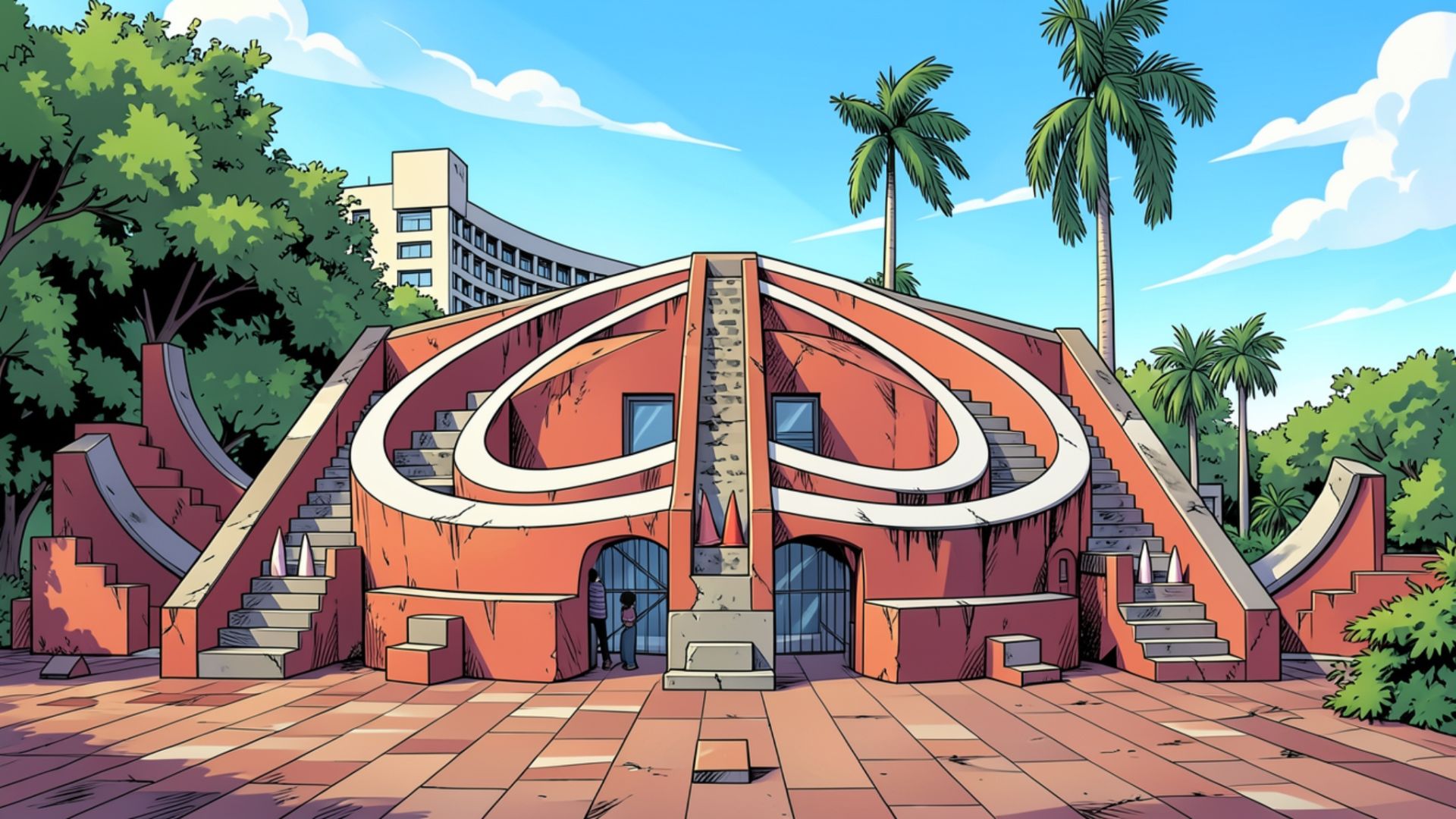
The ‘Jantar Mantar’ in New Delhi is an observatory designed to be used with the naked eye. It is one of the five Jantar Mantar observatories in India.
However, Delhi’s Jantar Mantar transitioned from an 18th century astronomical site to a prominent protest venue due to a 1990s government shift away from India Gate, its central location near Parliament, and its open layout.
For decades after independence, major political rallies and demonstrations took place at the Boat Club lawns near India Gate, but authorities banned and shifted demonstrations away from that zone following major disruptions in the late 1980s.
Following a 1993 ban on rallies directly near Parliament, the government and police officially designated Jantar Mantar Road as the primary controlled area for public demonstrations.
The Jantar Mantar Road was chosen and designated as a primary protest site in New Delhi because it offers a centralised location near key government institutions while remaining small enough for police to manage and secure.
Besides, its central location in New Delhi keeps protestors close to Parliament Street and national decision-makers, ensuring high visibility for media and political impact.
The Jantar Mantar in New Delhi has hosted countless demonstrations ranging from individual grievances to massive national political movements.
From a man who famously protested for years to prove he was legally alive after being declared dead on paper to the 2011 Lokpal agitation that scripted a new political narrative, the tree-lined boulevard has for the past few decades lent a space to anyone who wielded a placard and a cause.
Demonstrations, public assemblies, and hunger strikes; Jantar Mantar has had its share of protests, some mild gatherings which faded off quietly while others expanded into nationwide political shifts.
But, that is not to say that all demonstrations at the iconic democratic protest site achieve their full goals or chart a clear path forward.
There is no official or exact count of how many protests at Jantar Mantar have succeeded, as the term ‘success’ is subjective, rarely tracked as a formal statistic, and individual movements achieve varying degrees of partial or total goal fulfilment over time.
While some long-standing agitations such as anti-corruption movements or specific legislative advocacy campaigns have forced governmental reviews, policy shifts, or partial concessions, many other demonstrations disperse without meeting their primary demands.
Authorities frequently respond to high-profile sit-ins with administrative adjustments or inquiries rather than complete capitulation to organiser demands, making a binary ‘success/failure’ tally impossible to quantify.
Many movements face strict limits, police pressure, or shifting political conditions that cut short their long-term impact.
But, no matter what, as a regular site for farmers, student bodies, wrestlers, and political movements seeking national visibility near the seat of power, almost every major protest in India lands at Jantar Mantar.
For the first time, agitators from Goa opposing the controversial mega housing project in Karapur-Sarvan took their protests to the ‘hallowed’ portal of protests. Frustrated by state inaction and police crackdown at home, villagers escalated their 100-day grassroots movement to the national capital.
Its unmatched geographic proximity to the center of national political power and its status as a legally protected zone for democratic dissent makes Jantar Mantar an ideal protesting site. High media visibility makes it all the more popular with protestors.
A landmark July 2018 Supreme Court ruling officially designated Jantar Mantar as a legitimate zone for public assembly, affirming that staging peaceful protests here is a constitutional right.
Unlike other areas in Delhi where gatherings are routinely blocked under Section 144, authorities and the Delhi Police regularly issue structural permits for assemblies at this designated spot.
Due to its decades-old reputation as India’s protest epicenter, any movement choosing this venue naturally attracts immediate support from student unions, civil right groups and opposition leaders.
Authorities implemented localised internet suspensions across central districts of the national capital to obstruct crowd coordination and curb the spread of footage depicting police brutality.
History shows that when large groups of citizens try to march directly on government seats to demand answers, tensions flare and authorities often move to block them. The July 20th incident at Jantar Mantar is ample proof of the intense friction between youth-led demonstrations and state security measures.
Peaceful protests need not necessarily elicit similar responses from the authorities. In fact, they often receive varied responses from the ruling classes, ranging from active facilitation to restrictive containment, influenced by factors like public disruption, political context, and local laws.
An establishment faces sudden threats when systemic hubris, policy failures, or institutional blindness culminate in an unexpected public reckoning.
Standing as a central arena for free speech and constitutional rights in India, is the capital’s historic hub for public dissent and civic demonstration being stripped of its open democratic symbolism!
Comments (0)
Please login to post a comment.
No comments yet. Be the first to comment!