
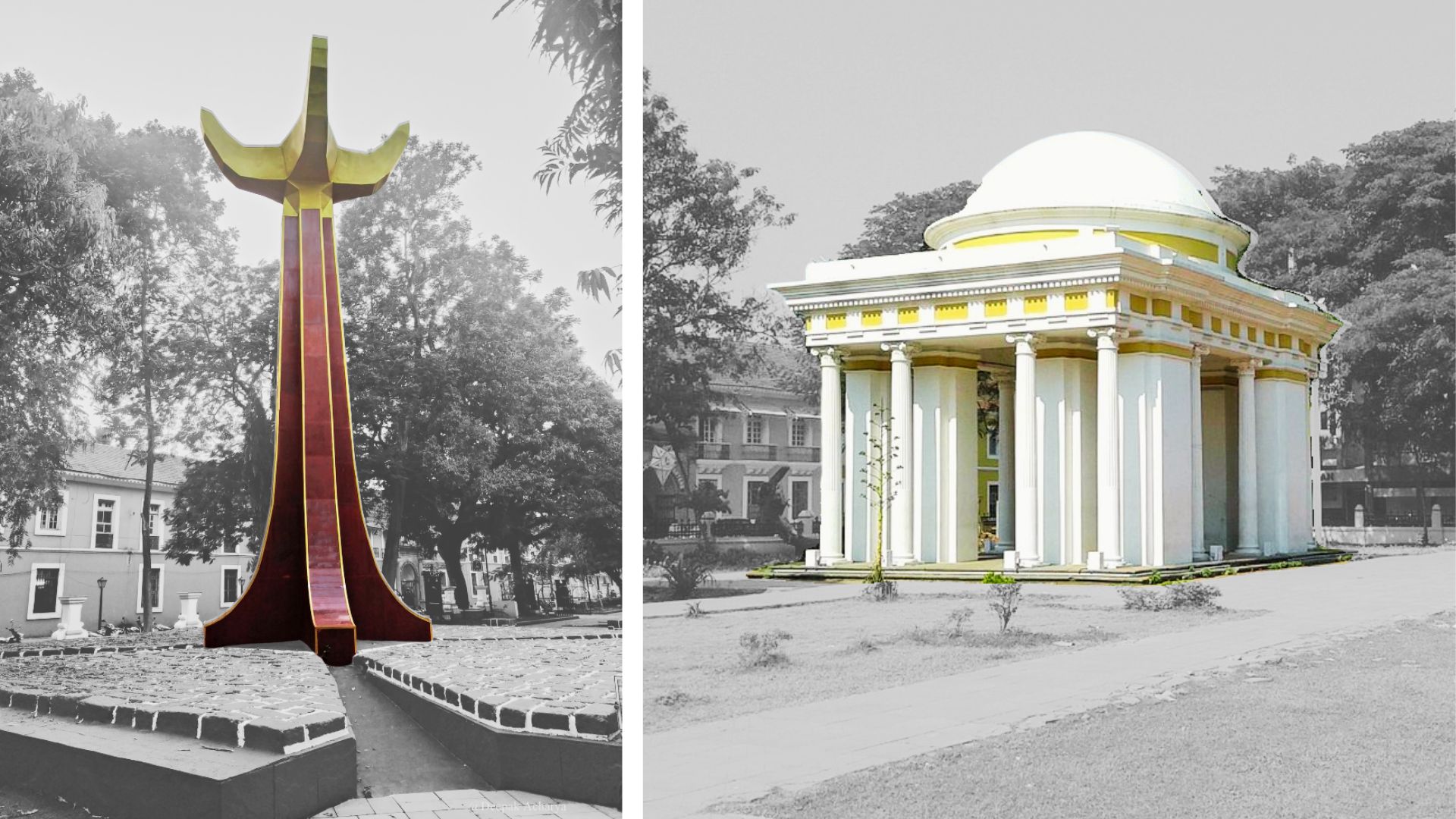
Situated in the heart of Panjim, Azad Maidan is among Goa’s most significant public spaces and serves as a focal point for commemorations linked to the state’s liberation movement.
FROM COLONIAL MONUMENT TO SYMBOL OF FREEDOM
The structure standing at Azad Maidan traces its origins to 17 February 1843, when the Portuguese administration laid its foundation as a tribute to Afonso de Albuquerque, the Portuguese military commander and statesman who served as the viceroy of Portuguese India from 1509 to 1515.
In the beginning, the site was known as Praça de Sete Janelas, or the Square of the Seven Windows. The name is believed to have been inspired by the building facing the monument, which had rows of seven windows. Today, this prominent building accommodates the Government Printing Press, Goa Police Headquarters, and the Institute Menezes Braganza Hall.
Designed along the lines of the Temple of Glory in Ancient Rome, the monument originally housed a bronze statue of Albuquerque, installed in 1847. After Goa attained liberation from Portuguese rule in 1961, the statue was removed and later placed in the Archaeological Survey of India Museum at Old Goa.
The domed monument has since been rededicated to Tristão de Bragança Cunha, regarded as one of the principal figures of Goa’s freedom struggle. His relics are preserved within the structure in a brass urn mounted on a granite pedestal.
MARTYRS’ MEMORIAL
A short distance away from the domed structure stands the Martyrs’ Memorial, erected by the Freedom Fighters’ Association to honour those who gave their lives for Goa’s liberation. Standing at a height of 14 m, the memorial incorporates a distinctive four-armed design surmounted by a pyramid. The four arms signify the contribution of freedom fighters from across India, while the pyramid symbolises their sacrifice and unwavering commitment to the cause.
Two stone pillars positioned beside the memorial carry the names of 67 martyrs who participated in the liberation movement. Notably, many of them came from regions outside Goa, reflecting the nationwide support the struggle received.
The memorial was conceived by architect JR Ralino de Souza and inaugurated in March 1973 by Lieutenant General KP Candeth, who commanded the Indian forces during Goa’s liberation on 19 December 1961 and subsequently became the territory’s first military governor. Engineers SV Gadgil and Audhut Kamat supervised its construction.
Adding a cultural dimension to the memorial is an inscription of a verse written by celebrated Goan poet Balakrishna Bhagwant Borkar, commemorating the courage and sacrifice of those who fought for Goa’s freedom.
Comments (0)
Please login to post a comment.
No comments yet. Be the first to comment!