
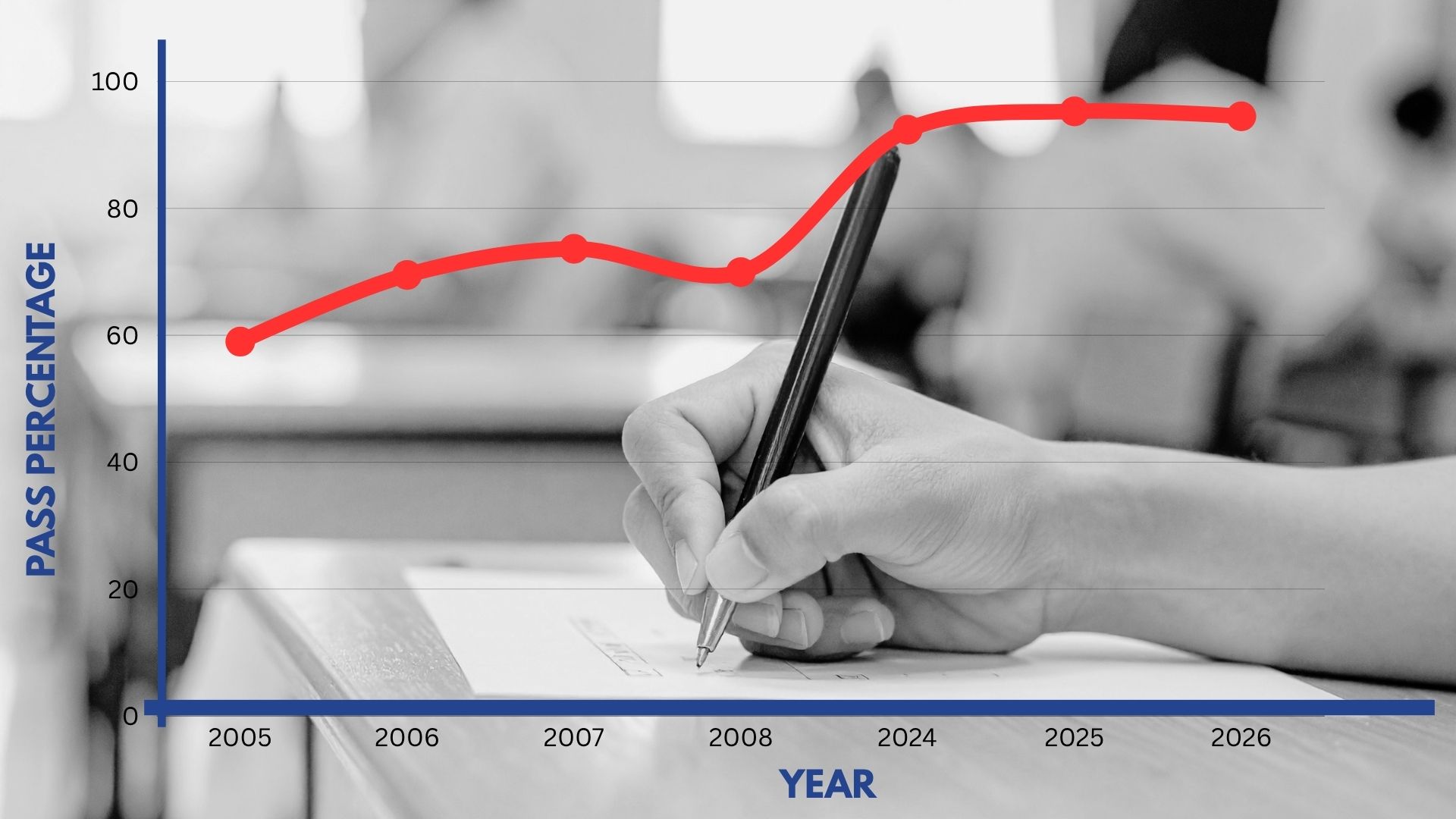
The pass percentage in this year’s SSC exams stood at 94.51, which statisticians will point out was less than in the previous year when it stood at 95.3 percent, but more than a year before that in 2024 when it was 92.38 percent. Goa has got quite accustomed to the SSC pass percentages in the 90s and during the pandemic years, this percentage had shot up to 99 percent, before climbing down to more reasonable figures. But, even as the state celebrates the high marks, have such high percentages always been the case in Goa?
Let’s rewind to two decades ago, to the year 2005, when the pass percentage at the SSC exam was nudging 60. Recorded at 59 percent that year, it was considered quite a favourable percentage for that exam. It wasn’t a low percentage as for a good two decades before that, the SSC pass percentage had remained in the 50s, for in 1984, the pass percentage at the SSC exam had been 55 percent.
The pass percentages at the SSC exam appear to have taken a leap from the year 2006 onwards. While in 2005 it had stood at 59 percent, in the following year, 2006, it had leapt to 69.51 percent and in 2007 to 73.63 percent, only to drop to 69.94 in 2008.
Explaining the rise in pass percentage may be difficult. In 2008, then chairman of the Goa Board, LMT Fernandes had said to the media, “We were unable to explain the jump from a pass percentage of 59 recorded in 2005 to 69.51 in 2006 and then to as much as 73.63 last year. Similarly, we also cannot state the reason for the drop in the overall pass percentage this year.”
While the Goa Board was unable to explain this, neither the jump nor the drop in 2008, teachers attributed the drop to the introduction of the NCERT syllabus. However, in following years, the percentage kept climbing, so in light of the syllabus change, either students found the NCERT curriculum to be more interesting or teachers were able to better explain the concepts to the students.
A rise in the passing percentage can, but does not necessarily, indicate an improved academic performance. There are a number of possibilities that can lead to the rise. It could mean that students may be better prepared, that teaching methods might have improved, or that schools are offering stronger support to the students. It may also reflect changes in curriculum, the NCERT syllabus for instance, or more effective exam preparation strategies.
It is also possible that the question papers may be easier or that evaluation standards and grading policies are more lenient. A higher pass percentage can, therefore, reflect a shift in assessment rather than a real increase in learning.
However, it is also a fact that students today are learning and doing far more than what their parents did. They are not learning merely what is contained in text books, but expand their minds through projects that schools give them to complete, and some of these topics are such that one would normally associate with students of higher education and not in high school. Clearly education levels are higher.
A rising pass percentage suggests overall improvement, but to understand what it truly indicates, you have to look at factors like exam difficulty, grading policies and overall education quality — not just the number itself. Before we celebrate, the Goa Board of Secondary and Higher Secondary Education or the Goa Directorate of Education, or both, should conduct a study to determine what is working well for the students. It would help plan for the future.
The writer is a senior journalist, author and editor
Comments (0)
Please login to post a comment.
No comments yet. Be the first to comment!