
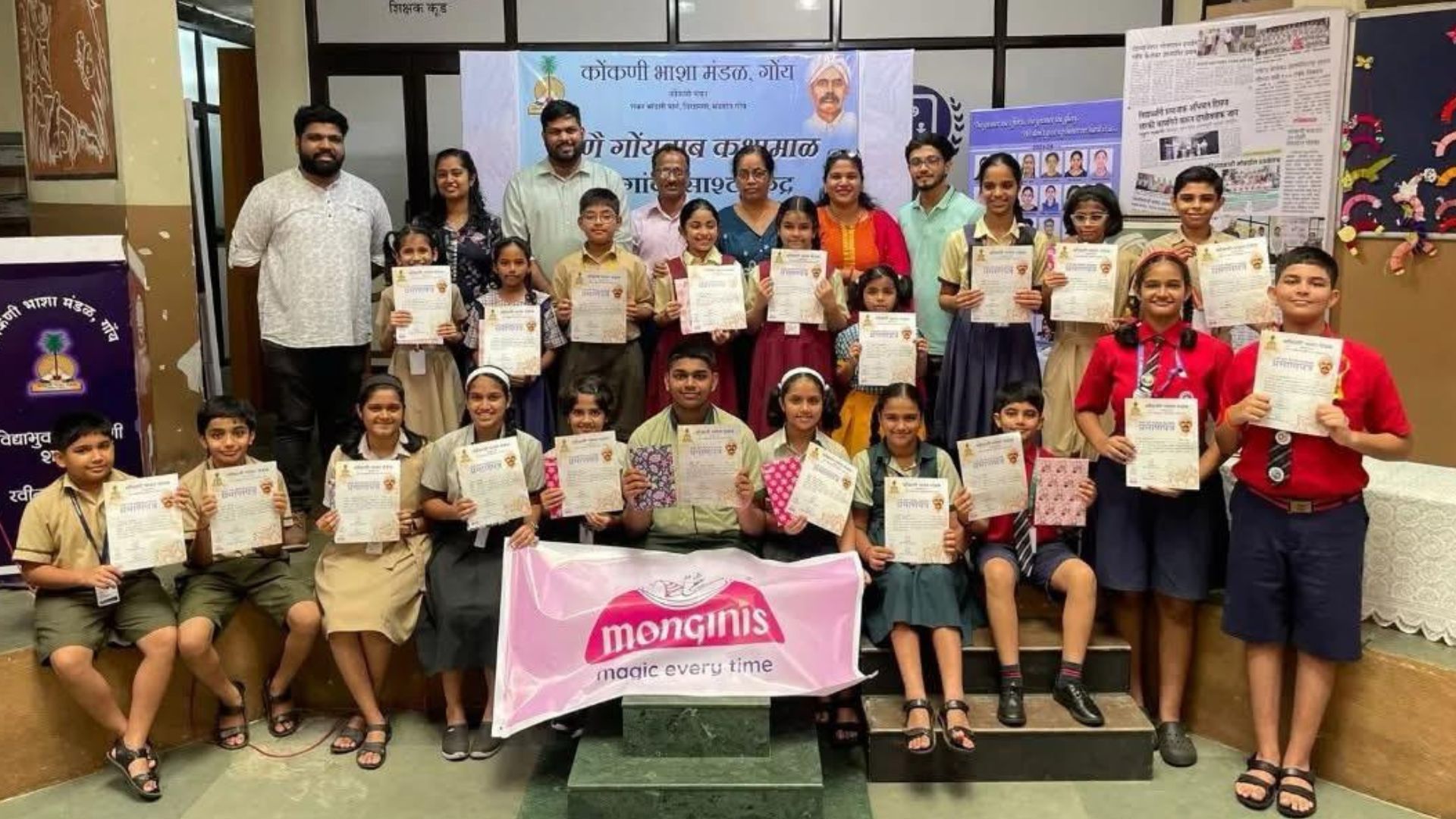
There are competitions that produce winners. And then, there are movements that shape generations. For 25 years, the Shenai Goembab Kathamal, organised by the Konkani Bhasha Mandal (KBM), has done the latter. What began as a storytelling competition has, today, become the largest celebration of Konkani storytelling in Goa and one of the state's most significant cultural movements.
As Kathamal celebrates its silver jubilee this year, it reaches yet another landmark. For the first time, the competition will be conducted simultaneously at 20 centres across Goa on a single day. Behind this remarkable feat lies months of planning, hundreds of volunteers, schools, supportive parents and, above all, thousands of children who continue to prove that stories remain the strongest bridge between language and identity.
JOURNEY FROM UNCERTAINTY TO STATEWIDE ACCEPTANCE
The success of Kathamal today makes it easy to forget that its journey was not always smooth. In its early years, the competition was concentrated in a handful of talukas. Organising centres in regions such as Canacona and Sattari often proved difficult. These areas, described as Marathi strongholds, did not initially witness the participation or support that Kathamal enjoyed elsewhere.
Questions were raised about whether a statewide Konkani storytelling movement could truly take root across Goa. But, over the years, Kathamal steadily won the confidence of schools, teachers and parents all over the state. Ironically, many of the very regions that were once considered difficult today register among the highest numbers of participants. Canacona, Sattari and other such areas have emerged as vibrant contributors to the competition, reflecting a simple truth that when people are given an inclusive platform to celebrate their language, they embrace it wholeheartedly.
FROM A TRAVELLING COMPETITION TO A STATEWIDE FESTIVAL
Kathamal has evolved dramatically in the way it is organised. In its earlier years, the competition travelled from taluka to taluka over several weeks. Each centre hosted its event on different dates, and the winners gathered for a grand state level finale. While this format allowed organisers to personally oversee every stage, it also demanded enormous time and logistical effort.
Today, Kathamal unfolds differently. Twenty centres across Goa will host the competition on the very same day. Coordinating such a large event requires meticulous planning, coordination and teamwork.
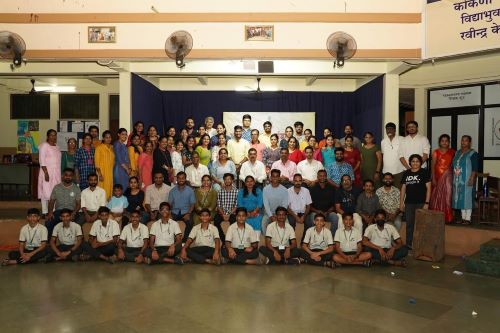
Yet year after year, the system works seamlessly. The credit belongs largely to an inspiring army of volunteers. Many of these are young men and women who once represented their own villages and institutions in the Goa Yuva Mahotsav. Their experience in cultural organisation has now become an asset for the Kathamal movement. They organise competitions in their own regions, coordinating with schools, arranging venues, managing registrations, assisting judges and ensuring that every child receives the same experience irrespective of where they participate.
BUILDING CREDIBILITY THROUGH FAIRNESS
Kathamal is conducted in three age categories. Every category requires a panel of three judges. This means each centre needs nine judges and with twenty centres functioning simultaneously, nearly two hundred judges must be available on a single day.
The Konkani Bhasha Mandal has invested significantly in training these judges. Most judges are young individuals who undergo workshops and orientation programmes before the competition. They are introduced to common evaluation parameters, marking systems and judging practices so that every participant is assessed by identical standards regardless of the centre.
This systematic approach has earned Kathamal credibility. Parents trust the results. Teachers respect the process. Participants know that they are evaluated fairly. In an era where questions of transparency frequently surround competitions, Kathamal has built a reputation for impartiality and professionalism.
CELEBRATING EVERY DIALECT
Perhaps Kathamal's most meaningful contribution has been its approach towards Konkani's linguistic diversity. Goa's Konkani is rich with regional dialects, each carrying its own rhythm, vocabulary and cultural memory. For many years, these differences often became points of debate.
Kathamal chose celebration over division. Children are encouraged to narrate stories in the dialect they naturally speak. Rather than asking participants to abandon their linguistic identity, the competition recognises every dialect as an authentic expression of Konkani.
The results have been deeply encouraging. Students from Pernem, Sattari and other dialect-rich regions have gone on to win at the state level while narrating stories in their own speech. Their victories stand as powerful reminders that Konkani's strength lies not in uniformity but in diversity. It has built respect across dialects.
CREATING READERS, WRITERS & STORYTELLERS
The influence of Kathamal extends well beyond the competition stage. Preparing a child for storytelling inevitably begins with reading. Teachers search for meaningful literature. Parents revisit old storybooks, visit libraries and encourage children to explore Konkani writing. In many households, storytelling becomes a shared family activity.
Some parents even go a step further. Unable to find the exact story they envision, they write original stories specifically for their children. Teachers too adapt and create narratives that reflect local culture and contemporary themes.
Thus, Kathamal has quietly encouraged original writing while simultaneously nurturing a reading culture across Goa.
BREAKING EVERY BOUNDARY
Perhaps no other literary competition in Goa matches Kathamal in its inclusiveness. Students from Konkani medium, Marathi medium, English medium and government schools participate together. Private English medium schools that may otherwise have limited exposure to Konkani literary activities enthusiastically send participants each year.
Schools are encouraged to organise preliminary competitions. Students first compete within their own institutions before representing their schools at their designated Kathamal centre. Significantly, certificates are awarded even to participants at the school level, ensuring that every child receives encouragement for taking part.
Thousands of students participate annually. Teachers, parents, librarians, writers and volunteers all contribute in different ways.
MINIMALISM WITH MEANING
One of the most interesting aspects of Shenai Goembab Kathamal is its simplicity. Unlike many large events that begin with elaborate inaugural ceremonies, Kathamal consciously keeps formalities to a minimum.
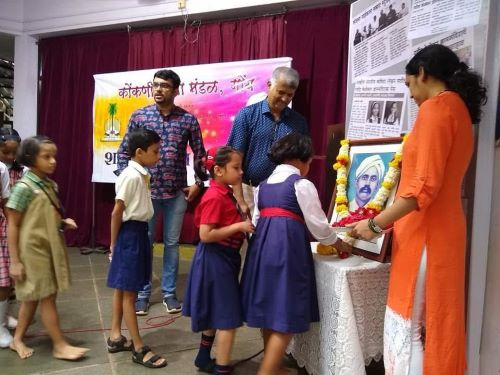
There are no lengthy speeches or grand protocols. Instead, the competition begins with children offering flowers to the portrait of Shenai Goembab, the visionary after whom the competition is named, reminding every participant that the focus of the day is not on dignitaries or ceremonies, but on stories, language and the children who carry them forward.
A CELEBRATION OF BOOKS
Alongside every Kathamal centre is another attraction – the book exhibition. As children, teachers and parents gather for the competition, they also eagerly browse and purchase books and educational material published by the Konkani Bhasha Mandal over the years.
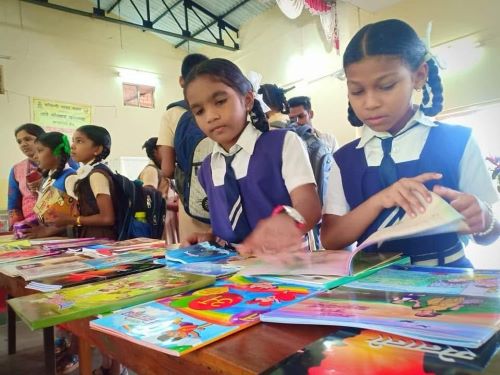
The exhibition reflects KBM's investment in creating quality literature and learning resources for young readers. For many families, Kathamal is not only a storytelling competition, but also an opportunity to discover new books, and nurture a love for Konkani literature.
A TRIBUTE TO SHENAI GOEMBAB'S DREAM
Every edition of Kathamal is a tribute to Shenai Goembab. There was a time when Konkani struggled for recognition and many did not even consider it an independent language. It was Shenai Goembab who sowed the seeds of linguistic pride and inspired generations to believe in the identity and richness of Konkani. The sight today is a testament to how far that dream has travelled.
Thousands of children from every corner of Goa proudly narrate stories in Konkani, teachers and parents actively encourage them, and the language resonates across twenty centres in a single day. It has been a long and remarkable journey for Konkani, and one can only imagine that Shenai Goembab would have looked upon this celebration with immense pride. Every child who takes the stage is living proof that the seeds he planted continue to flourish.
A STATEMENT OF KONKANI'S STRENGTH
The silver jubilee of Shenai Goembab Kathamal is not merely an anniversary. It is evidence of what sustained cultural work can achieve:
- Twenty centres functioning simultaneously.
- Thousands of children narrating stories.
- Hundreds of trained volunteers and judges.
- Schools participating together.
- Parents reading and writing stories.
- Children proudly speaking in their own dialects.
- These are not simply statistics, but signs of a language that is alive.
In an age dominated by short videos, and shrinking attention spans, thousands of children still stand confidently before an audience to narrate stories in Konkani. That image alone speaks volumes about the future of the language.
Languages do not survive merely because governments recognise them. They survive because families speak them, schools encourage them, institutions nurture them and children carry them forward with pride. For 25 years, the Konkani Bhasha Mandal has ensured exactly that.
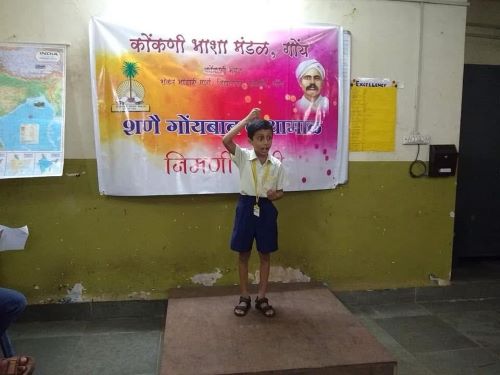
Every child who walks onto the Kathamal stage carries more than a story. They carry memory, imagination, and culture. They carry the voices of grandparents, the wisdom of folk traditions and the promise that Konkani will continue to flourish in the years to come.
The greatest success of Shenai Goembab Kathamal lies in the hundreds of young storytellers it has inspired over the past quarter century. As KBM celebrates 25 years of this extraordinary initiative, it celebrates the enduring strength of Konkani itself. For as long as Goa's children continue to tell stories in their mother tongue, Konkani will never merely survive. It will thrive.
Comments (0)
Please login to post a comment.
No comments yet. Be the first to comment!