
BY ARTI DAS
In India, festivals are not just about rituals; they also speak of the changing seasons, harvest time, and the importance of ecology in our lives. One such festival is Sharad Navratri, which commences with the onset of autumn (September–October). This year, it began on October 11 and culminates with Dussehra or Dussro on October 20.
Navratri, as we know is associated with Shakti, or goddess worship, and thus, it symbolises earth’s fertility and creation.
“In our tradition, the earth and women are considered equal. Just as seeds germinate in the womb of the earth, creation takes place in the womb of a woman,” says teacher and folklorist, Pournima Kerkar.
She explains that during these days, nine types of grains (Navadhanya) are sown and nurtured by sprinkling them with milk and turmeric water. These include paddy, wheat, ragi, corn, black gram, mung bean, cowpeas, horse gram and others. By the ninth day, green and yellow shoots emerge.
She adds, “Women adorn their hair with these sacred shoots. In the past, this ritual sowing was done in every household, but nowadays, it is limited to temples.”
GOAN FLORAL TRADITION
In Goan households, an interesting ritual is performed during this festival, known as maal ghaalap or vastra ghalap. For this, wooden sticks are placed in front of the tulsi vrindavan, and flower garlands are hung on them. A fresh garland is added each day, according to the number of the day. Thus, on the first day, one garland is placed, and on the ninth day, nine garlands are offered. On the tenth day, which is Dussro, one garland is offered.
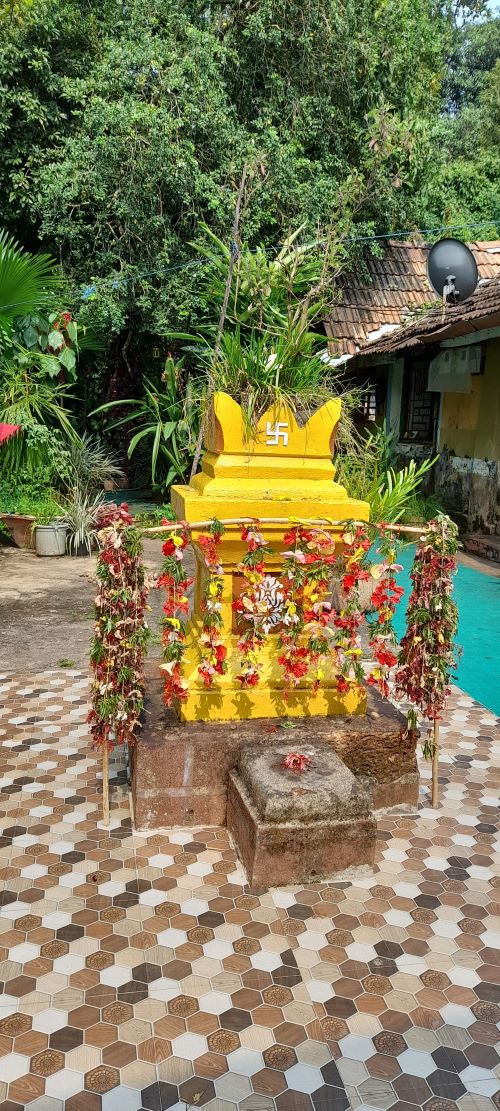
In Goa, garlands are offered during Navratri
All these garlands are generally made at home by the women of the family. They consist of local, colourful flowers like hibiscus, shabduli, and anant, along with leaves of the aralia plant.
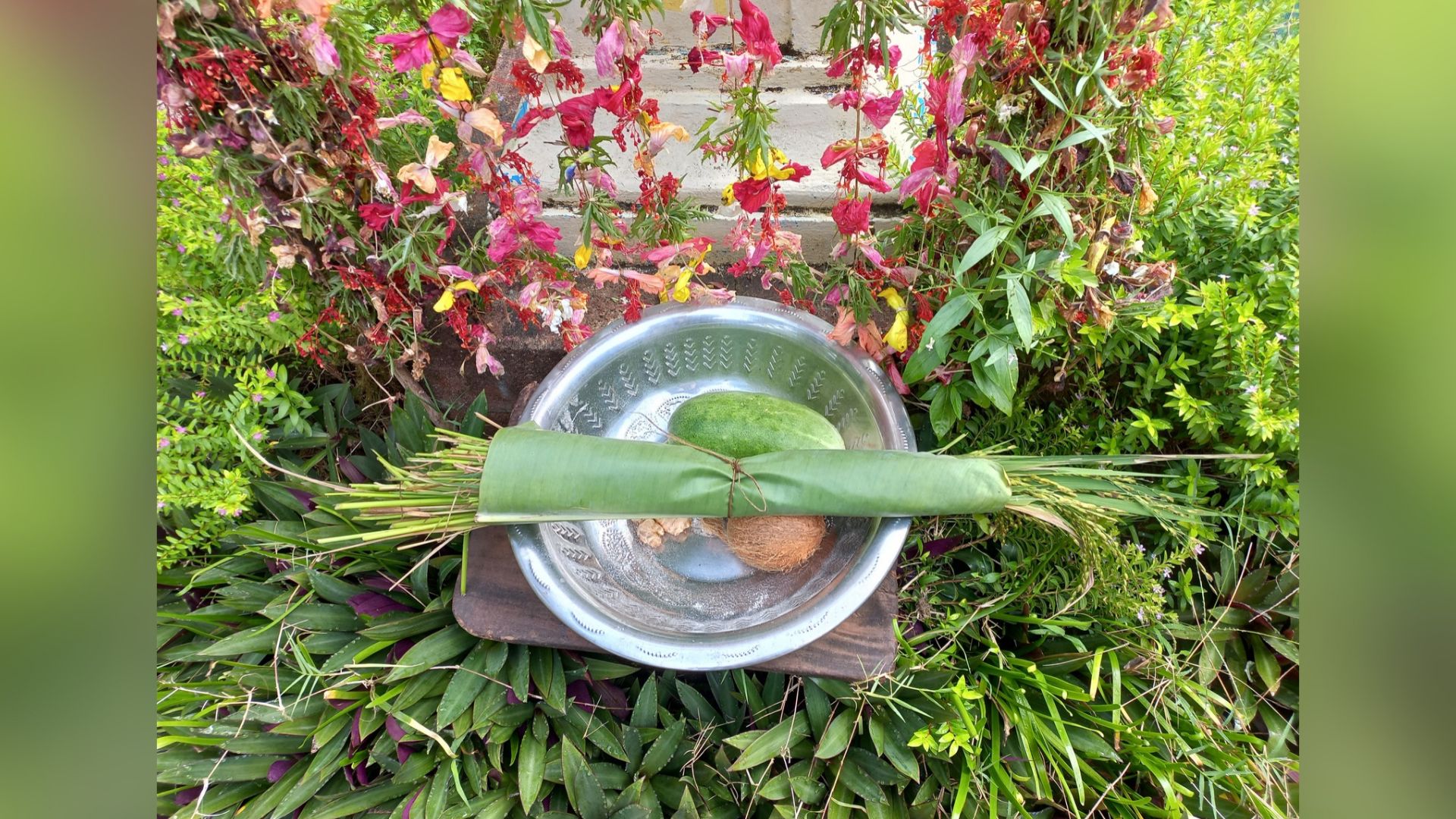
During this festival, the paddy harvest season begins. In many Goan villages, paddy is harvested during Navratri and brought to the local temple to seek blessings. It is then distributed throughout the village. In each home, the harvested paddy is first placed near the tulsi vrindavan along with a coconut, and worshipped. The blessed paddy is also hung at the main entrance of the house. Usually, a garland of marigold flowers and mango leaves is hung, but in many parts of Goa, paddy is used instead.
GOA’S UNIQUE NAVRATRI TRADITIONS
In Goa, Navratri is associated with Makharotsav, which is celebrated in various temples across the state, especially in the Ponda region. During this festival, the deity is placed in a makhar — a rectangular wooden structure resembling a swing, suspended from the ceiling. It is elaborately decorated with colourful glass, paper, flowers and other materials, with the idol of the goddess placed inside it. But why a swing, and what is its significance?
Vidya Kamat, secretary of the Centre for the Study of Mythology and Culture (CSMC), explains, “The association of the swing with fertility has deep roots in Indian culture. In agrarian communities, women traditionally went into agricultural fields and tied swings to large trees, enjoying them as they swayed in the breeze. Ancient Indian literature also contains several references to swing festivals and swinging episodes in poetry and drama.”
She further explains the tradition observed at the Ramanathi Temple in Ponda, where Navratri is celebrated for eleven days instead of nine. “During the first nine days, Goddess Kamakhya presides over the festivities and is taken out in a procession. On the tenth day, Lord Ramanath presides over the celebrations, while on the eleventh day, Goddess Sateri is taken out in a procession in her ambari, or elephant chariot.”
Along with these, several ritual-centric events are held in temples across Goa, such as the Gondhal ritual at the Shri Navdurga Temple in Poinguinim, Canacona. Here, the tarang and satri (representations of the deities) are brought out, and men, known as Gade, perform a ritual dance called Gondhal.
NAVRATRI ORIGIN
Like many festivals, it is difficult to trace the exact origins of Navratri. “We do not know exactly when or where the Navratri festival originated in India. However, it is an ancient tradition closely connected with the agrarian lifestyle and the cycle of cultivation,” says Kamat.
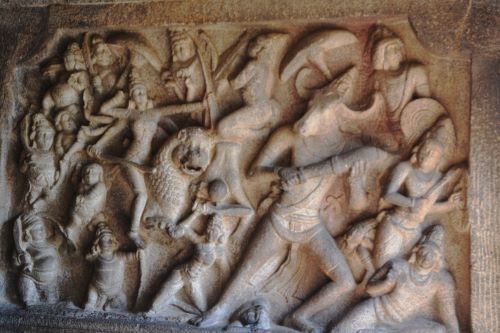
Mahishasura Mardini panel at Mahabalipuram, Tamil Nadu, from the late 7th Century
Referring to archaeological evidence associated with the festival, she mentions sculptures of the goddess Mahishasuramardini. “The earliest known sculptures of Mahishasuramardini from Mathura, dated to around the 1st –3rd centuries CE, suggest that the worship of the goddess was prevalent during this period. In Goa, sculptures of Mahishasuramardini dating from approximately the 10th–13th centuries CE have been found.”
Arti Das is a Goa-based freelance journalist who enjoys writing about art, culture and ecology
Comments (0)
Please login to post a comment.
No comments yet. Be the first to comment!