

It's Rang Panchami, and while the rest of Goa celebrated Holi on the 3rd of March this year, the little village of Fatorpa, in South Goa, is bathed in gulaal on the auspicious day of Panchami. Gulaal is a festival awaited as eagerly by the Goddess Shantadurga, as it is by her devotees since it celebrates the goddess’ homecoming from Fatorpa to her original home, in Cuncolim, for Chatrotsav.
WHO HOLDS THE HONOUR
One of the most striking elements of the festival is the tall, decorated umbrellas.
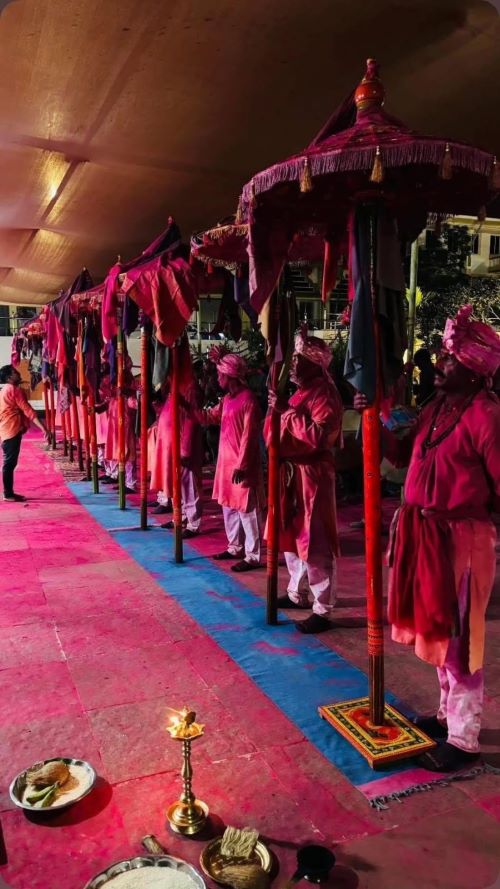
The 12 'sotreos', seen at the festival, represent 12 'vangodds' (communities). Photo: Ratish Dessai
Commonly referred to as Magnichi devi, Goddess Shantadurga who is at the centre of the occasion, is said to come to the aid of those who pray to her with pure devotion. “Devotees sometimes promise her a sotree (umbrella), if their prayers are answered,” Desai continues. “This year, a devotee has offered a red sotree, since his prayers were granted.”
FESTIVE GLAM
Of the 12 ceremonial umbrellas (sotreo) used during the festive procession, 11 are white, while one is red. The umbrellas are made of velvet fabric, so as to make the cleaning process easy.
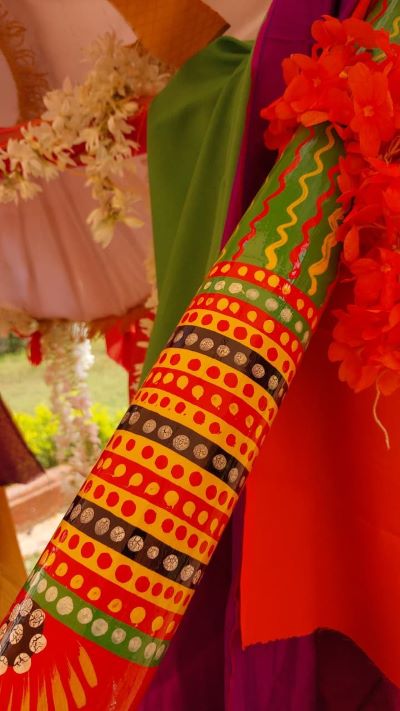
The handles of the umbrellas are painted in the traditional 'Chitari' art style. Photo: Kanaka Desai
Decorated with flowers and garlands, the sight of these umbrellas dancing and twirling to the beats of traditional percussion instruments, such as dhol, tashe etc is enthralling.
After the festivities, the umbrellas are cleaned, washed and stored for use, once again, the following year. Unless they undergo wear and tear, they are not replaced.
BEHIND THE FESTIVAL
The story goes that during the Portuguese invasion of Goa, Goddess Shantadurga is said to have appeared in the dreams of the villagers. She instructed them to construct a temple at Fatorpa, where she had to be taken, so as to protect her from being destroyed. The goddess is believed to have travelled along a certain route, which the festive procession follows to this day.

Goddess Shantadurga is at the heart of the festivities. Photo: Kanaka Desai
THE FESTIVE EXPERIENCE
This is my fifth year walking with the procession, the 12 sotreos, and the palkhi (palanquin) all the way from Fatorpa to Cuncolim and back — a journey of roughly 12 km — complete with vivid colours and the rhythmic sound of drumbeats filling the air, as thousands of devotees walk along the ancient path.
Along the route, households and devotees offer slices of freshly-cut watermelon, cold drinks, chilled water, sugar and jaggery — a refreshing treat for the faithful making the hours-long journey.
As the procession approaches Tolleabhat (in Cuncolim), believed to be the goddess' original home, Konkani hymns praising Saibinn Mai — as she is affectionately called by the local Catholic community — blend with the sounds of drumbeats and bhajans/aartis. Religious differences take a backseat as the joy and the festival spirit grips the air at Rang Panchami.
Comments (0)
Please login to post a comment.
No comments yet. Be the first to comment!