
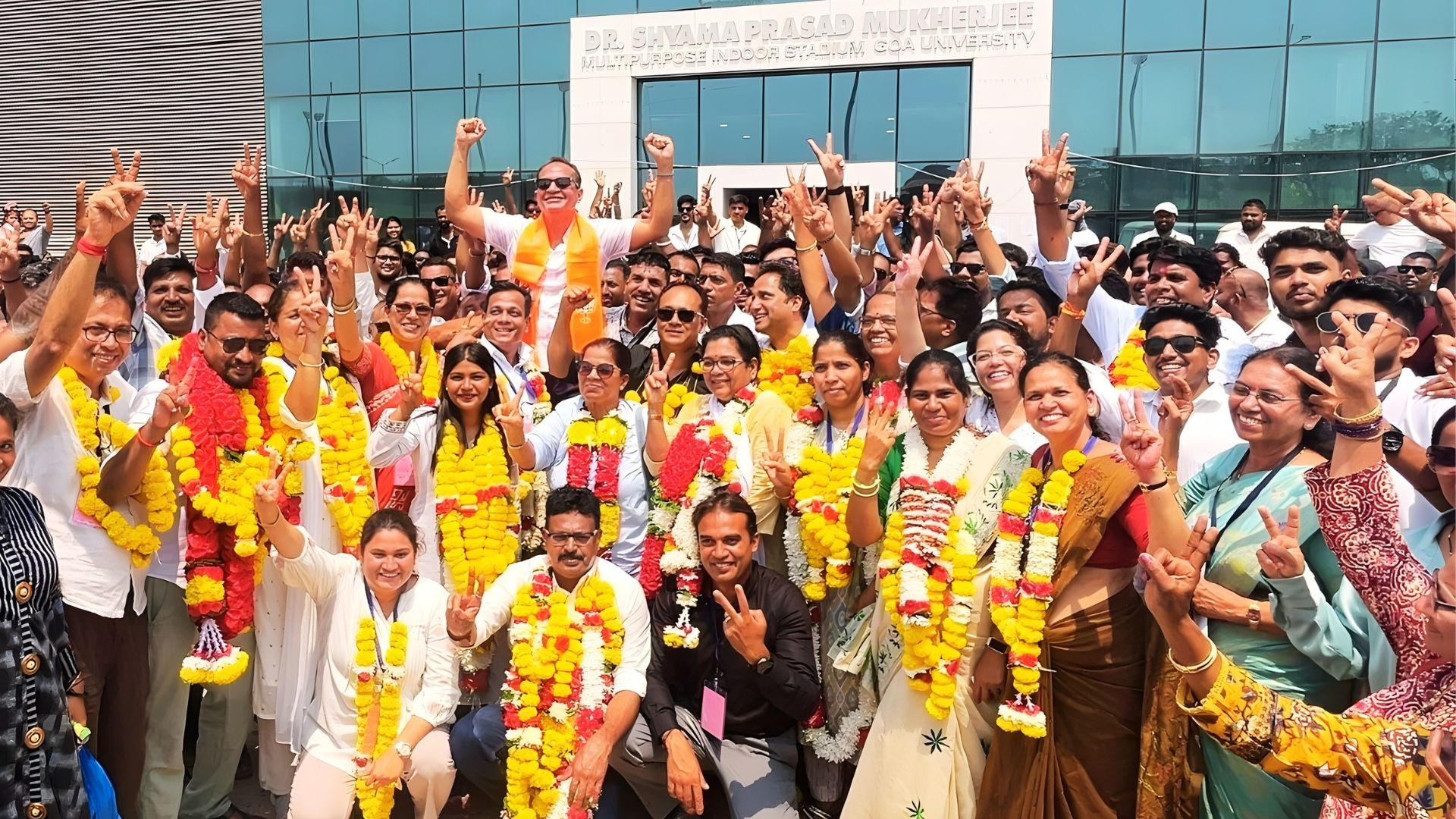
The elections to the Corporation of the City of Panaji (CCP) have delivered a decisive verdict. The BJP–Babush Monserrate-backed panel ‘Together for a Progressive Panaji’ swept the polls, winning 27 of the 30 seats, leaving just three seats for the Utpal Parrikar-led ‘Ami Panjekar’ panel. On paper, it was a landslide. But, beneath the numbers lies a contest that many would argue was not quite a free and fair battle.
From the outset, the scales appeared tilted in favour of the ruling establishment. The delimitation and reservation of wards were finalised almost on the eve of the elections, leaving the opposition with little time to prepare or organise candidates.
More troubling was the manner in which ward boundaries were altered by the Directorate of Municipal Administration, a government department itself, without any structured public consultation or transparent logic. Localities were shifted and wards reshaped in ways that appeared arbitrary, reinforcing the perception that the playing field had been redrawn to suit the ruling side rather than the democratic process.
The process resembled, in many ways, a cricket match where the home team prepares the pitch to suit its strengths. Imagine a scenario where the home team not only prepares the pitch but also has the umpires, the match referee, the match commissioner and even the cricket board seemingly on its side. In such a contest, the visiting team starts the match already at a disadvantage. That perception, fairly or unfairly, surrounded the CCP elections.
The issue of voter rolls also raised eyebrows. Candidates were reportedly provided poor quality rolls where even the faces of voters were difficult to identify. In the past, coloured rolls were easily available to citizens and candidates alike with online soft copies, making it simple to identify voters. The absence of such accessible rolls this time created suspicion among many that the election machinery had displayed blatant partisanship tilted towards the ruling side.
A more troubling issue was highlighted by Jack Sukhija, who won Ward 17 by two votes in one of the closest contests of the election. Sukhija pointed out that some citizens refused to vote because the ballot papers were numbered, creating a perception that votes could be traced back to individual voters. Even if such fears are misplaced, the mere perception that secrecy could be compromised is a serious setback to the spirit of a free and fair democratic process.
Yet, acknowledging these concerns should not take away from the political credit due to Babush Monserrate and the BJP. Having been in power for a long time, they possess a well-oiled organisational structure across the CCP wards that fall in Panaji and Taleigao constituencies. In contrast, opposition candidates often had to rely largely on their own limited networks. In a campaign window of barely 20 days, this was like running a 200-metre race while the ruling side had already started 50 metres ahead.
This apart, unlike earlier civic elections where citizens’ platforms such as FOGG or PINK had actively mobilised Panaji residents highlighting Panjim related issues, no such citywide civic campaign emerged this time. As a result, many critical urban issues received limited attention.
Ironically, Panaji citizens had endured four years of hardship due to Smart City works and allegations of substandard execution, concerns that even Mayor Rohit Monserrate and Babush had acknowledged in earlier months. Yet the election discourse rarely centered on these issues. There was also a noticeable indifference among activists and civil society groups, many of whom chose to stay away, viewing the contest largely as BJP’s A Team versus BJP’s B Team, rather than a battle between the ruling side and a credible opposition.
The absence of a strong social media as well as issue-based campaigns also meant the contest increasingly became a personality battle between Babush Monserrate and Utpal Parrikar, rather than a broader debate about reclaiming Panaji from its urban challenges.
Babush Monserrate, it must be said, has always been a formidable force in Panaji politics, known for his aggressive campaign style and formidable resources. Even during the era when Manohar Parrikar dominated Goan politics, Babush managed to hold his ground in municipal politics, winning successive council battles by margins of 19–11, 17–13 and 16–14. When the BJP and Babush combined forces, the results became even more decisive, producing a 25–5 victory in the last CCP elections. This time, the margin has widened further to 27–3, aided by the structural and political factors that shaped this election.
Panaji voters also appeared to focus largely on localised ward-level issues, rather than broader citywide concerns. While the opposition faced structural limitations, it could arguably have done better by starting early, identifying candidates ward by ward, and building grassroots networks well before the election announcement. The ruling side’s superior organisation would likely still have prevailed, but the contest might have produced more competitive numbers.
The 2022 Assembly election in Panaji provides an interesting context. Utpal Parrikar, carrying the legacy of his father Manohar Parrikar, came close to victory, but eventually lost to Babush Monserrate by a slender 716-vote margin. Significantly, the Congress, AAP and other candidates together secured nearly 4,500 votes in that contest. Babush may have consolidated the areas where he fell short in the past four years, but the numbers still suggest that a united opposition which does its homework well could alter the dynamics in 2027.
One bright takeaway from the election is the victory of Jack Sukhija, the grandson of the legendary Jack Sequeira, the Father of the Opinion Poll. Sukhija’s incredible win introduces a credible new political face in Panaji, someone who could emerge as an alternative third option in the 2027 Assembly elections. Surendra Furtado likewise could pitch for his son Leonid Furtado, another new entrant, to join the battle for Panaji Assembly for the Congress.
For now, Babush Monserrate clearly holds the upper hand in Panaji’s political landscape. But Assembly elections are a different arena where voters often choose a new government rather than a councillor. If the opposition learns from this defeat and manages to unite, 2027 could yet produce an intriguing contest in the capital city.
The writer is the Joint Secretary of the Goa RTI Forum
Comments (0)
Please login to post a comment.
No comments yet. Be the first to comment!