
A month ago, this column noted that India’s capital markets have a well-documented capacity to absorb geopolitical shocks and recover. The pattern across 1991, Kargil, Iraq, Ukraine and Covid has been one of sharp, but ultimately temporary pain, with eventual normalisation. That assessment stands. But what also stands, and what the current West Asia crisis has once again exposed in plain sight, is the structural condition that makes every such episode more painful for ordinary Indians than it needs to be. Markets may recover. Household budgets are less elastic.
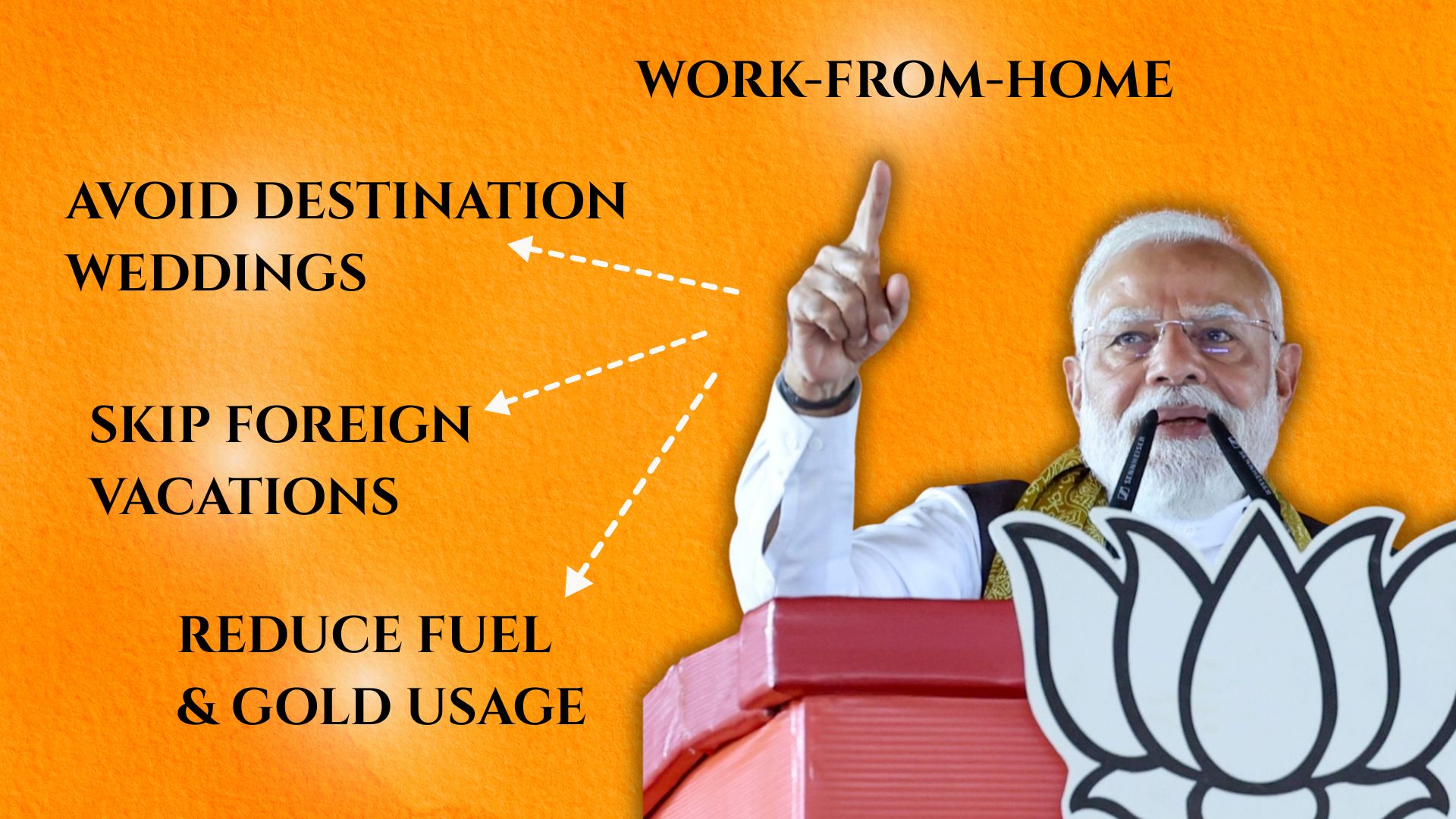
There is something quietly insulting about being asked to carpool and skip foreign holidays by the same government that spent twelve years failing to solve the very problem those sacrifices are meant to address. Prime Minister Modi's call for “patriotic discipline” on fuel consumption is not wrong in isolation. Conservation is always sensible. But as a response to a deepening structural problem (one that has quietly worsened across twelve years of governance), it is, at best, a band-aid applied to a wound that required surgery. Asking 140 crore citizens to tighten their belts is not an energy policy. It is a substitution for one.
NUMBERS THAT EXPOSE TWELVE YEARS OF FAILURE
The numbers deserve to be stated plainly. When the current government took office in 2014, India imported roughly 78% of its crude oil. Today, that figure stands between 88 and 90%, occasionally breaching 91% in a single month. Twelve years of Atmanirbhar Bharat and we are measurably more dependent on foreign oil than when the slogan was coined.
Domestic crude production has not risen to fill the gap; it has fallen. Output has declined 22% since 2014-15, a contraction spanning eleven consecutive years. The old wells are drying up, new discoveries have not arrived at scale, and the promised exploration renaissance has largely remained on paper.
A weakening rupee compounds the injury. In 2014, a US dollar cost roughly Rs 60-62. Today, it costs close to Rs 95. Every barrel of imported crude, that cost India Rs 6,000 a decade ago, now costs over Rs 9,000 (before accounting for any spike in global prices). When West Asia disrupts supply, this double vulnerability (higher volumes imported, at a sharply weaker exchange rate) converts an external shock into domestic inflation with brutal efficiency.
The pain does not stop at corporate balance sheets or stock market indices. It reaches every household that fills a petrol tank, every family that cooks on an LPG cylinder, every autorickshaw driver whose margins evaporate before he has had a chance to raise his fares.
POLICY FAILURES THAT MADE INDIA MORE VULNERABLE
This is not a streak of bad luck. It is the accumulated result of policy choices that were, at each turn, more politically convenient than strategically sound.
Auction rounds for new exploration blocks have produced limited ground-level activity. Environmental clearances have moved slowly. Private capital, unwilling to wait years for approvals on fields that may take a decade to produce, has looked elsewhere. The government suppressed retail fuel prices for extended periods, directing oil companies to absorb losses (a measure that sounds compassionate, but eliminates the one price signal that might have nudged conservation organically). When the suppressed reality eventually breaks through, as it always does, there is no policy cushion remaining. Only the appeal to citizen sacrifice. It is a pattern that has repeated with clockwork regularity, and the government's response has not materially changed.
RENEWABLES CANNOT HIDE THE DEEPER NEGLECT
Renewable energy represents a genuine achievement, and the expansion of solar capacity deserves its credit. But solar panels do not fuel the trucks that move India’s goods or the motorcycles that carry its workers. Wind turbines do not keep the lights on when the air is still. The electricity grid is not yet equipped to absorb the transport sector, and electric vehicles (for all their promise in press releases) remain financially out of reach for the majority of Indian families who cannot spend two lakh rupees on a two-wheeler replacement.
Nuclear power, which is firm, scalable, and insulated from both weather and commodity markets, has received insufficient policy priority for years. Its potential sits largely unrealised while the import bill compounds. Boasting about renewables while neglecting nuclear and domestic oil production is not energy independence. It is a selective reading of a problem that is, in fact, getting worse.
PEOPLE SHOULD NOT PAY FOR THE GOVERNMENT’S DELAYS
Every crisis, from COVID to Ukraine to West Asia, finds India scrambling from the same exposed position – emergency supplier diversification, drawdowns from strategic reserves, appeals to citizens. The short-term fixes work, in their way. And, the structural causes survive, intact, waiting for the next episode to expose them all over again.
The common Indian did not create this vulnerability. They did not slow-walk the exploration auctions, suppress the price signals, or defer the nuclear investments. They were told to trust the vision of a self-reliant India, and they did. What they are being offered in return, when global oil prices spike and the rupee slides, is a request to sacrifice a little more.
Real Atmanirbharta is not a hashtag or a speech. It is not even a citizen's willingness to carpool. It is cheap domestic energy that does not hold the nation hostage every time a tanker route gets disrupted. It is oil fields that produce, reactors that run, and a grid that works. It is the unglamorous, decade-long, detail-heavy work that governments are elected to do and that this one has consistently deferred.
Until that work is done, “patriotic discipline” is just the sound of a government asking its people to pay for its own unfinished business.
The writer is a management consultant, specialising in enterprise risk, governance and policy controls
Comments (0)
Please login to post a comment.
No comments yet. Be the first to comment!