
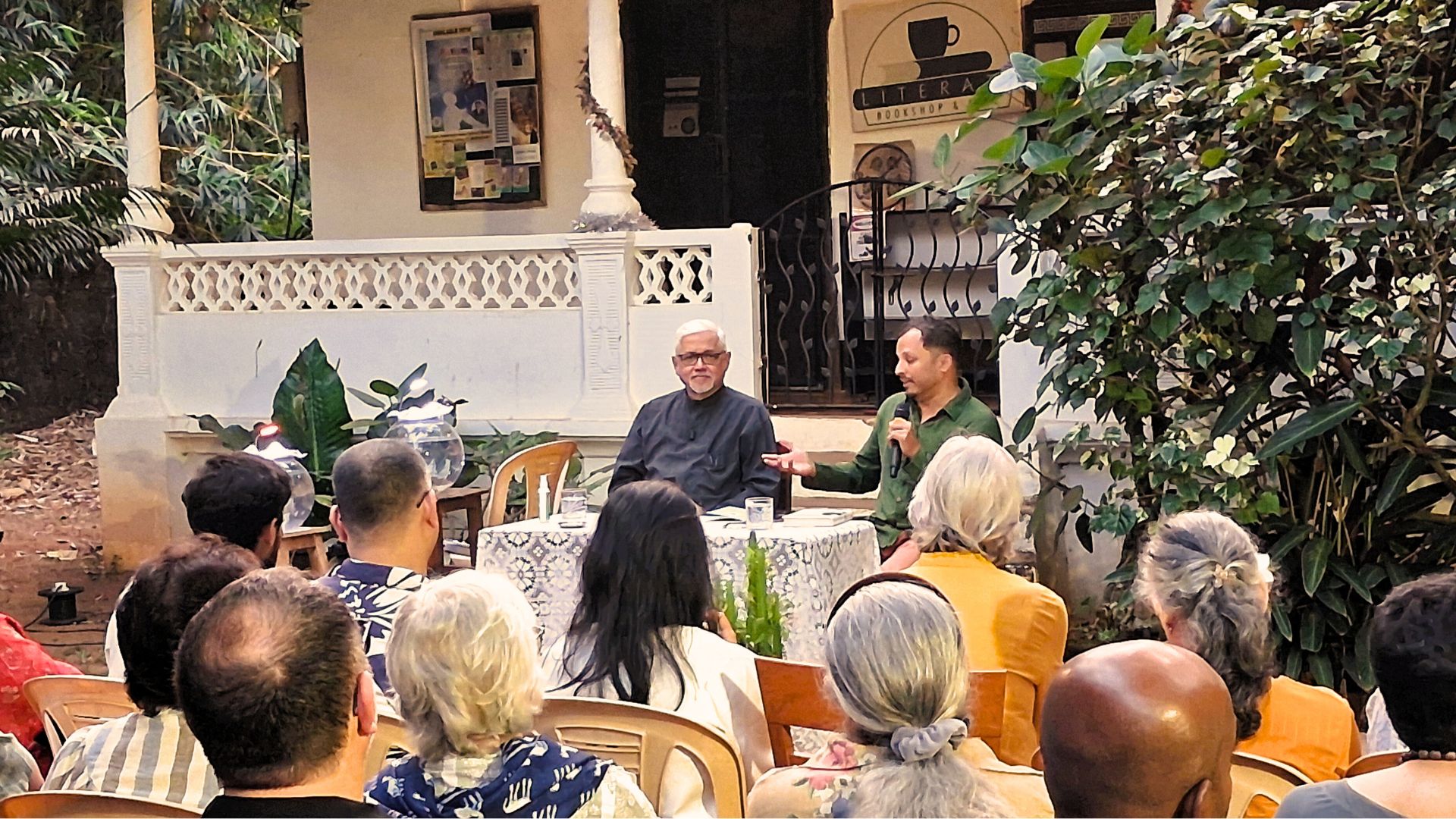
Acclaimed writer and Jnanpith awardee Amitav Ghosh believes that science is not only about precision, measurement and predictability assembled in a linear fashion, but is also full of “weirdness,” especially in the realm of quantum physics. Thus, his latest novel, Ghost-Eye, which deals with past life and reincarnation, is not against science as such, but against capitalist thinking.
Ghosh was speaking with marine conservation scientist Aaron Lobo at the book launch event at Literati, Calangute, where he elaborated on how indigenous ways of living are now under threat due to the capitalist logic of production. He cited examples of fishermen, farmers, and peasants, who share an innate relationship with living things.

ABOUT THE BOOK
Ghost-Eye tells the story of three-year-old Varsha, born into a vegetarian family, who begins demanding fish for lunch. Through this, Ghosh uses food as a lens to explore environmental themes.
Ghosh stated that he loves food and enjoys cooking meals for friends and family. “Food is a primary way to engage with one’s environment. I also grew up in the crowded city of Kolkata, and it was largely through food that I became attentive to my surroundings,” he
He also added that numerous studies show that memories of past lives are linked to both food and language. On this point, Lobo noted that food biodiversity is closely connected to language diversity.
The book, set in Bengal, mentions the popular fish, illish, only once. On this, Ghosh explained that the fish is predominantly consumed by high caste people, while his protagonist believes she is a fisherwoman. He also noted that Bengal’s rivers are silt-heavy, giving each river a distinct ecosystem and contributing to the region’s rich fish diversity. For this reason, he wanted to focus on overall biodiversity rather than just highlighting a ‘trophy’ fish.
FISH FACTS & MORE
The discussion then turned to different types of fish, such as koi maach, tilapia and shrimp. Lobo noted that India ranks first or second in farmed shrimp production, with these farms concentrated in just three districts of Andhra Pradesh. He added that farmed fish are often loaded with antibiotics and are highly unsustainable.
Ghosh further added that there is currently a movement in Bangladesh against shrimp farming, as it involves digging up agricultural land and filling it with saltwater, which destroys everything around it.
Speaking about indigenous communities, Ghosh remembered the renowned environmentalist Madhav Gadgil, who passed away on 7 January. He noted that Gadgil paid close and meticulous attention to indigenous practices and knowledge. “In India, the binary between industrial forms of rationality and other forms of thinking never existed,” he added.
Lobo further stated that the world’s six percent indigenous population, whom Gadgil called “ecosystem people,” protect 30 to 60 percent of global biodiversity. In contrast, urban dwellers, or “biosphere people,” are part of an extractive economy that comes at the expense of the ecosystem people.
He also explained the concept of “intergenerational amnesia,” which refers to how each generation gradually loses its connection to ecology, along with the associated indigenous knowledge systems.
Ghosh described the current era as the “age of greed” and, quoting Italian philosopher Giorgio Agamben, remarked, “We need to see what remains.”
Comments (0)
Please login to post a comment.
No comments yet. Be the first to comment!