
After much fanfare, the 56th edition of the International Film Festival of India (IFFI) has concluded. This makes it an apt moment to reflect on the journey of the festival, which has now completed 21 years in Goa. Over the years, IFFI has undoubtedly come a long way in terms of scale, visibility and prestige.
However, an important question still remains unanswered: has the festival truly succeeded in nurturing and developing a vibrant cinema culture in Goa?
It has indeed helped, and this is reflected in the vision of young Goan filmmakers whose short films were selected in the Goan Film Section of IFFI this year. The five films showcased in this section stood out for their strong storytelling and sound technical execution. Above all, the filmmakers’ commitment to the craft was clearly evident.
For instance, Sainath Uskaikar’s documentary My Dad Invented Vada Pav offers an interesting take on the history of Mumbai’s iconic snack. Few would imagine that this humble vada pav was invented as recently as 1966, conceived as a means of self-reliance and shaped by the political climate of Mumbai at the time.
Another film worth mentioning is Halad by actor-director Sobhita Kudtarkar. The short film delves into themes of domestic violence and patriarchy, set against the backdrop of a rural Goan village. In a similar vein is Zero Bulb, directed by 22-year-old filmmaker Soham Bhende as a student project at the National Institute of Design (NID). This film also explores patriarchy, conveyed through a succinct yet powerful conversation between two women from different generations.
This year, there was no Goan or Konkani film in the Indian Panorama section. Instead, two Goan films — Claudia by Rajendra Talak, and Pilot by Nitesh Pires — were screened as part of the Gala Premiere.
I would also like to point out that the Indian Panorama section, which screened 30 feature films and 20 non-feature films, largely failed to live up to expectations, barring a few notable exceptions. As in previous editions, the section included mainstream Bollywood films that had already been released in theatres, such as Chaavaa, or were easily accessible on OTT platforms, like Kesari 2.
IFFI should instead serve as a platform to showcase the best and freshest cinema, particularly documentaries and independent films that are otherwise difficult to access through theatres or streaming platforms.
INTERNATIONAL FILMS
IFFI 2025 featured over 240 films from 81 countries, including 13 world premieres, four international premieres, and 46 Asian premieres. The festival showcased several compelling films, particularly those that have been garnering significant acclaim on the international festival circuit.
Notable among them were the South Korean film No Other Choice by Park Chan-wook, the German film Sound of Falling by Mascha Schilinski, and It Was Just an Accident by renowned Iranian filmmaker Jafar Panahi. Panahi’s film, in particular, proved immensely popular, earning two repeat screenings— more than most other films, which typically had only one.
Among the notable films was the opening feature, The Blue Trail by Brazilian filmmaker Gabriel Mascaro. This dystopian drama follows the journey of 78-year-old Teresa as she discovers her own path to freedom.
The closing film, A Useful Ghost, is a delightfully bizarre narrative about a ghost trapped inside a vacuum cleaner. Through a series of humorous and surreal situations, the film comments on the socio-political realities of Thailand. Director Ratchapoom Boonbunchachoke makes the narrative convincing throughout.
 Silent Friend was one of the films which was screened at IFFI 2025
Amidst all the films, the one that lingered with me was Silent Friend by Ildikó Enyedi. Its protagonist is an ancient ginkgo tree, serving as a silent witness to three interconnected stories spanning three generations. The film poses a thought-provoking question: as we watch the trees, do they, in turn, watch us?
GENERALLY SPEAKING
Speaking of this year’s IFFI management, the movie scheduling this year was noticeably improved. However, there were still some technical glitches with the app during film bookings.
Overall, the 56th IFFI in Goa was well organised, and I believe screening films at Porvorim, Margao, and Ponda was a smart decision. It not only helped distribute the crowd, but also gave local audiences greater access to these films. That said, it is sad to note that INOX Margao was not included as a venue this year.
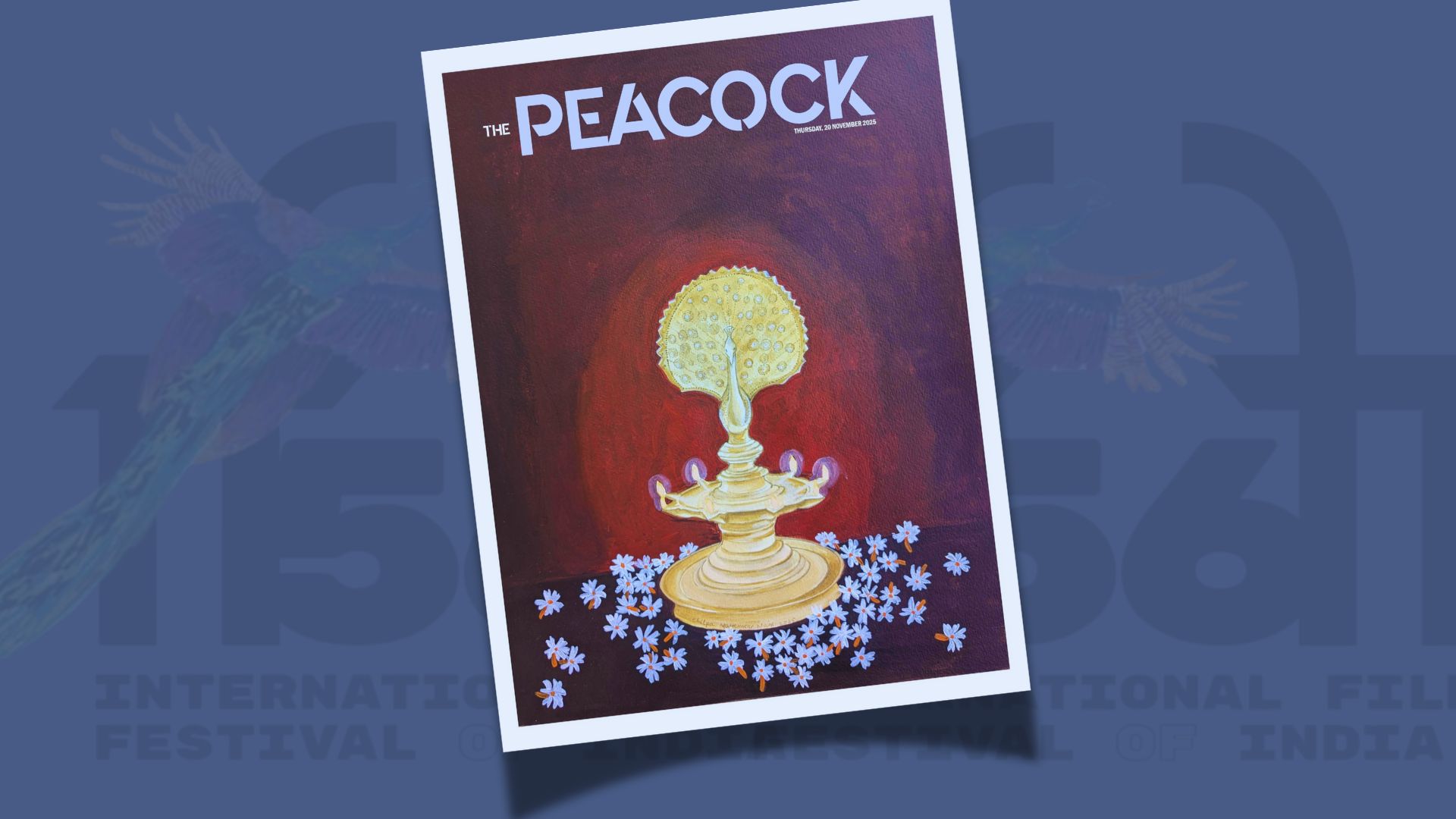
On a concluding note, I would like to highlight Peacock, the official daily of IFFI, edited by Vivek Menezes. Its standout feature is the front cover, which reflects the spirit and ethos of Goa in unique ways. This year, the cover was designed by artist Shilpa Mayenkar Naik, who beautifully captured Goa’s subtle charm through elements like flowers and kaavi art.
Additionally, photographer Assavri Kulkarni’s centrespread vividly conveyed the vibrant atmosphere of the festival. With its thoughtful mix of film-related and Goa-centric articles, Peacock is not only an enjoyable read, but also serves as a wonderful keepsake of IFFI — until the next edition.
Comments (0)
Please login to post a comment.
No comments yet. Be the first to comment!